

Dohc-WP
Ron Burgundy
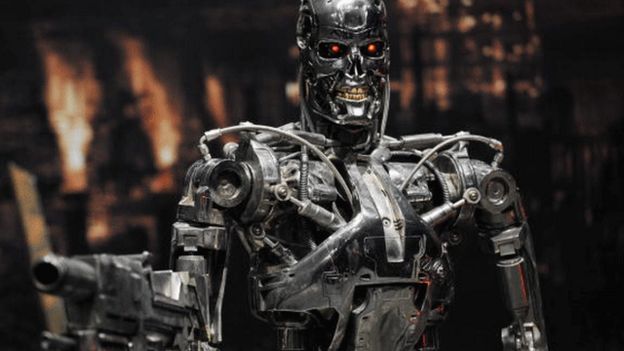
Picture the scenario - a sentient machine is "living" in the US in the year 2050 and starts browsing through the US constitution.
Having read it, it decides that it wants the opportunity to vote.
Oh, and it also wants the right to procreate. Pretty basic human rights that it feels it should have now it has human-level intelligence.
"Do you give it the right to vote or the right to procreate because you can't do both?" asks Ryan Calo, a law professor at the University of Washington.
"It would be able to procreate instantly and infinitely so if it and its offspring could vote, it would break the democratic system."
This is just one of the questions Prof Calo is contemplating as he considers how the law has to change to accommodate our ever-growing band of robot and AI companions.
He does not think that human-level intelligence is coming to machines any time soon but already our relationship with them is raising some interesting questions.
Recently there was a tragic accident at a VW factory in Germany, when a robotic arm, that moved car parts into place, crushed a young man who was also working there.
Exact details of the case are not yet released but it is believed human error was to blame.
Volkswagen has not commented on the incident.
While industrial accidents do happen, the law gets a little fuzzy when it involves a robot. It would be unlikely that a human could sue a robot for damage, for example.
"Criminal law requires intent and these systems don't do things wrong on purpose," said Prof Calo.
How the world deals with the rise of artificial intelligence is something that is preoccupying leading scientists and technologists, some of who worry that it represents a huge threat to humanity.
Elon Musk, founder of Tesla motors and aerospace manufacturer Space X, has become the figurehead of the movement, with Stephen Hawking and Steve Wozniak as honorary members.
Mr Musk who has recently offered £10m to projects designed to control AI, has likened the technology to "summoning the demon" and claimed that humans would become nothing more than pets for the super-intelligent computers that we helped create.
The pet analogy is one shared by Jerry Kaplan, author of the book, Humans Need Not Apply. In it, he paints a nightmarish scenario of a human zoo run by "synthetic intelligences".
"Will they enslave us? Not really - more like farm us or keep us on a reserve, making life there so pleasant and convenient that there's little motivation to venture beyond its boundaries," he writes.
Human intelligence will become a curiosity to our AI overlords, he claims, and they "may want to maintain a reservoir of these precious capabilities, just as we want to preserve chimps, whales and other endangered creatures".
Philosopher Nick Bostrom thinks we need to make sure that any future super-intelligent AI systems are "fundamentally on our side" and that such systems learn "what we value" before it gets out of hand - King Midas-style.
Setting the controls for AI should come before we crack the initial challenge of creating it, he said in a recent talk.
Without clearly defined goals, it may well prove an uncomfortable future for humans, because artificial intelligence, while not inherently evil, will become the ultimate optimisation process.
"We may set the AI a goal to make humans smile and the super-intelligence may decide that the best way to do this would be to take control of the world and stick electrodes in the cheeks of all humans.
"Or we may set it a tough mathematical problem to solve and it may decide the most effective way to solve it is to transform the planet into a giant computer to increase its thinking power," he said during his talk.
Source: BBC