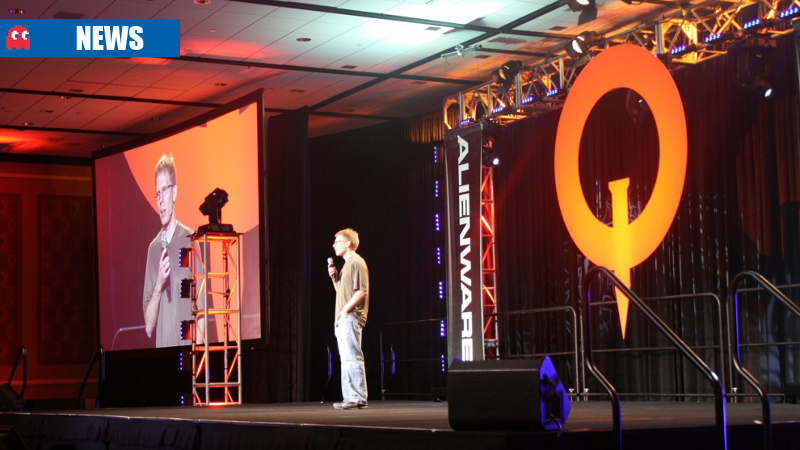


Speaking to attendees at the Quakecon gathering in Dallas, Texas, John Carmack sat down for an astonishingly long two and a half hours and said everything he needed to say about the state of the games industry, the console wars, the PC Master Race, and the future of the games that fans want from his development studio, id Software.
Like veteran developer Mark Cerny (another fascinating speaker), Carmack’s talk was interesting because not only did it focus on game design, but also his approach to hardware as an engineer and game engine creator. He keeps in close contact with both Microsoft and Sony because he believes that the console market continues to play a vital role in the shaping of gaming as a hobby that everyone can pick up.
Along with words of wisdom for budding developers at the conference, Carmack also had criticism and harsh words for companies attending the event as well.
On the console wars
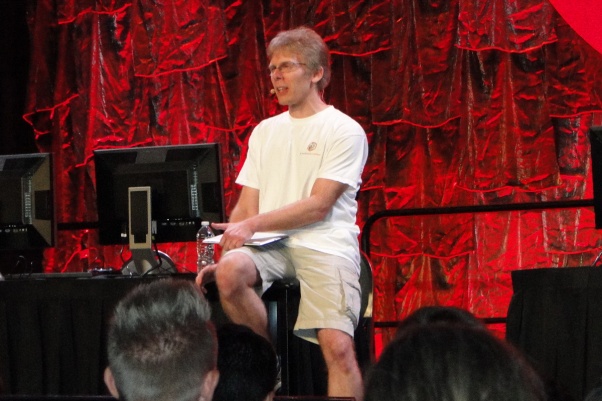
John Carmack at Quakecon 2013
Carmack began his discourse with the topic of the next-generation consoles – the Sony Playstation 4, Microsoft Xbox One, and Nintendo Wii U.
Said Carmack, “We have a good handle on the optimizations of the previous generation of consoles to really extract every ounce of performance and create some interesting content. The advantages of a new generation of consoles are very obvious, and that is particularly exciting, but the previous generation had strengths that we’re still exploring.”
Touching specifically on the hardware, Carmack said he was glad that both major consoles had chosen to spec their devices so closely to each other to attract interest from developers who were already familiar with the x86 platform on the desktop.
Echoing the thoughts of the rest of the industry, Carmack also said that he believed the hardware advantage would enable AMD to take the lead in the gaming performance crown.
“There are other advantages for AMD with their domination of next generation consoles, and it will come in the form of software optimizations for AMD’s CPU architectures. These console APUs are not entirely HSA compliant, but they do implement some shared memory advantages. Over time, we will see a lot of the gaming software (and physics) become more optimized for AMD which will improve their position in gaming circles,” Carmack said.
Vision for the future of hardware
Carmack took some time to elaborate on what he saw for gamers in the future and it was surprisingly in line with what Microsoft was offering with the Xbox One, before they reneged on their offering to satisfy gamers that weren’t ready to adopt their always-online policies.
He envisions that in future, consoles will ship without disc drives because we will download or stream games from the cloud, and cloud processing will be used for scenarios not sensitive to latency.
He also feels that the concept of ownership when it comes to games will go away, replaced wholesale by a licensing and free-to-play model that will offer gamers more choice as to what they want to play and how much they wanted to pay.
On Kinect and input latency
Carmack also doesn’t seem to like Microsoft’s Kinect 2.0 controller all that much. He likens the technology to “a zero-button mouse, but with latency,” noting that previous versions of Kinect were not only a little inaccurate, but lacked features.
Carmack admits that Kinect has come a long way from its initial inception, but ultimately still has issues which prevent widespread adoption, of which latency plays a big part.

Kinect for Windows demo
Speaking on the Kinect and its always-on microphone, Carmack said that the backlash against Microsoft was overstated. He believes that some things are inevitable and that giving up some privacy for the convenience that online services give us is not only required, but a step towards the future.
He specifically mentions Facebook, Instagram, FourSquare, and Twitter as being far easier to use to track us than the NSA’s spy programs and notes that many of us already carry GPS-enabled devices and adopt always-online policies through use of services such as Steam and Origin.
Source: Youtube
More industry news
AMD Crossfire-saving Catalyst driver hits beta
Logitech refreshes PC peripherals lineup





 Loading ...