
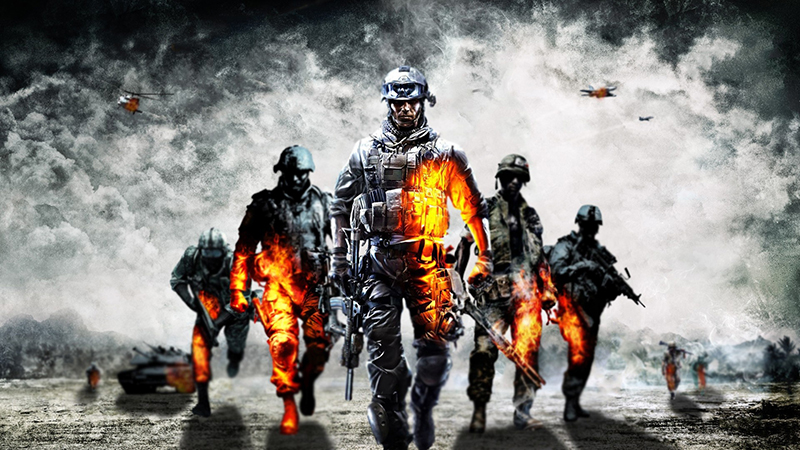


No one was surprised when DICE’s Development Director, Dan Vaderlind, announced that they had started development on a new Battlefield game.
https://twitter.com/mrVaderdan/status/675317213302247426
So we thought, why not talk about some of the things that hampered Battlefield 4’s experience, and how DICE might do things a little better this time round.
Most importantly is that it doesn’t need to one up Battlefield 4, which, frankly, is Battlefield 4’s biggest problem – minus the sizable number of bugs still present.
In trying to outdo Battlefield 3, Battlefield 4 incorporated a lot of additional junk that mitigated the experience of it all, distracting you away from the core experience of Battlefield.
First up, however, how about a different setting?
Battlefield 5 doesn’t need to be set in the distant future, nor does it need to be located in the past.
There’s a lot happening today that’s well worth building a game around. That’s not to say we wouldn’t be opposed to a futuristic setting, just as long as it provides a new environment for us to test our mettle.
Battlefield 4 offered much the same overall feel as Battlefield 3, only worse. That’s hardly a fitting formula for a sequel.
Why stop there, though? This is DICE’s opportunity to rework and reinvent the class system, or add new vehicle types and variations of the ones used in prior titles.
Bloatfield
There’s something intrinsically satisfying about unlocking equipment – it’s Battlefield’s equivalent of loot.
That said, there’s just too many pieces of equipment to unlock that really don’t contribute all that much, that feel like they’re there just for the sake of having things to unlock.
This makes balancing the game rather difficult, inevitably reducing the viability of a good portion of your arsenal.
Instead, DICE should focus on diversifying the functionality of the gadgets available, if they even go that route.
Give each class very specific roles, forcing players to work together to capture objectives.
Instead of having four different types of unmanned vehicle, introduce a gadget that makes spotting opposing players impossible, via a wireless jammer of sorts. Should a player leave the proximity of the jammer, they’re able to spot once again, and the rest of the team will see whatever is marked.
Or what about a grappling hook that allows players to scale buildings. That way, an opposing team has the opportunity of retaking a roof without requiring to parachute in – something that leaves you way too vulnerable to risk most of the time.
In return for the ability to do something that is otherwise far more difficult to do, it will force players planning to scale a building to abandon a potentially useful gadget, like the defibrillator, ammo packs or the SOFLAM.
What about a signal blocker for TUGS? Or, how about an adrenaline shot for the assault class, boosting their movement speed but reducing their health or regeneration?
We also need some sort of tool for engineers that assists in clearing vehicles from terrain they’re stuck on. It’s a much better alternative than having to use C4.
Do you even aim bro?
Perhaps one of the biggest issues with Battlefield 4 is that every weapon, or at least nearly every weapon, has a lock-on or fire-and-forget mode. They play the game for you.
This is particularly frustrating for helicopters as the range of the Igla and Stinger are outrageous. And don’t get us started on mines.
Mines are perfectly okay to use, we understand their place, but they’re almost impossible to spot and mark, giving vision of them for allies.
You can be looking directly at them and they’ll refuse to be marked.
Vehicles need a lot of love
In Battlefield 3, vehicles were a powerful asset in the right hands, able to accomplish feats it would take multiple boots on the ground to otherwise achieve.
To reduce the impact of vehicles, they had long spawn times that meant destroying a vehicle would keep it off the map for some time.
Players worth their salt were also keenly aware that irrespective of the vehicle, you could only effectively deal with two or three opposing players at a time, whether they were on foot or in vehicles themselves.
That meant that for each new threat attempting to take you out, the risk of loss grew exponentially. You had to pick your targets carefully, and more often than not required assistance from your allies to push forward.
Battlefield 4 initially took vehicles in completely the wrong direction, opting to nerf virtually every aspect so that they might be less of an issue for infantry play.
They did so by introducing ammo counts, reducing the effectiveness of countermeasures as well as reactive armour, and improved the damage done to them if a critical point was hit. But they didn’t stop there.
Battlefield 4 has introduced a near-absurd number of anti-vehicle gadgets and weaponry, increasing the killing power of every class multiple times over – most of which came by means of lock-on or fire-and-forget weaponry.
What DICE should be doing is finding more ways of incentivising squad play. A well-coordinated squad can hamper virtually any vehicle’s day, and Battlefield 4 was the perfect opportunity to improve their effectiveness.
In Battlefield 5, DICE needs to find a middle ground. Vehicles need to be far more effective than any single soldier, that’s their point, but less effective as the numbers rack up against them.
Like we suggested earlier, effective vehicle countermeasures are important, but does everything need to be lock-on or fire-and-forget?
Spoon feeding your community is often deleterious to maintaining an enthusiastic player base. Introduce skill caps to a few of the more effective weapons, thereby rewarding those players who master their use. But not so much that you get to our next, final problem.
Jets can F#*K right off
I know that I’m going to get a lot of flak for this, but jets need a huge reworking. Their current role is unclear; they’re just too good at everything they do.
In Battlefield 4, jets are the most effective counter to helicopters, other jets, attack boats, IFVs and tanks. What?
Vehicles needn’t prescribe to an exact rock-paper-scissors mechanic, some are just going to be better in more situations than others – Battlefield’s particular mechanics favour mobility over raw damage, for example, which is why the IFV (infantry fighting vehicle) is usually more effective than a tank.
Jets, however, are a whole different story.
Skilled jet pilots, minus internet hiccups, can only really be brought down by other skilled jet pilots. Should a skilled pilot take to the air in one of these abominable aircraft, they’re there to stay.
You can forget about shooting them down because simply popping your ECM and flying into the skybox, avoiding all threats until your health starts to regenerate and the ECM is ready, is all it takes.
Even in the case where an MAA (mobile anti-air), a couple soldiers and a helicopter are focussing a jet down, a skilled pilot will easily avoid all of it.
That’s because nothing is able to prevent jets from retreating into territory no one else can tread, and rather quickly too.
Why are jets able to render a vehicle immobile and very nearly destroy it in a single strafe run? The MAA, that’s why.
It also means that jets are able to reduce attack boats, tanks and IFVs to scrap metal, and without any of them having much of a chance of defending themselves – the skill of the player driving the tank etc. is irrelevant.
Jets are effectively jacks of all trades, masters of all.
In opposition to this, when tanks or IFVs go unchallenged, it’s almost always because the opposing team isn’t committing enough resources to bringing it down. And even in the case that they are, the opposing team is just committing an equal amount, or more, to keep it alive.
While it may seem unfair, consider that it means a good portion of the opposing team is tied down to a singular vehicle, a vehicle you can easily out manoeuvre if necessary – they’re also limited on ammo, so they’ll eventually go down.
Helicopters, on the other hand, don’t need as many resources dedicated to them, but while they can cause a lot of damage if left unchecked, they are easily corralled by a well-coordinated squad or two. Heck, an average MAA user is enough to be a menace to even the most skilled helicopter pilots, as long as he has a little cover and backup.
Jets don’t really have any of this to concern themselves with, with their users regularly dying once or twice in an entire round, and racking up ridiculous kill counts too.
While jet pilots will undoubtedly be pissed should their effectiveness against everything under the sun be drastically reduced, it doesn’t make sense that there’s this one object in the game that is by far and away the most effective asset on the map.
That’s not good game balance.
DICE clearly wants more from Battlefield 5, but we’re a little worried about their need for “more features. More extras. More destruction.”
That’s all well and good; we definitely do want more – lots of it. But we want what’s there, the core experience of Battlefield, to be more polished, balanced and reliable.
More destruction would be sweet, though.
Until then, you might want to play
Games you can play this week – survivalists and superheroes
5 FPS games we can’t wait to play in 2016






 Loading ...

Ugh Mygaming, Jets in BF4 were horribly underpowered compared to BF3, when every tank/AA/APC had active protection you’d spend a good chunk of your time just trying to get through that, nevermind the complete lack of rocket pods or cover.
Everything aside, I enjoyed BF3 and 4.
3 more than 4 though.