


PlayStation’s decision to end physical discs for its consoles from 2028 boils down to one thing: margin.
This is according to research company Alinea Analytics, which found that the improved margins when going digital-only outweigh the potential ramifications of any backlash from the playerbase.
Sony recently announced that it would end physical disc production in January 2028 for new games released on PlayStation consoles.
The reason given for this decision was that it was a response to shifting trends in consumer preference.
“This is a natural direction for Sony Interactive Entertainment to adapt to consumer trends as the general preference for digital media significantly outpaces physical discs,” said Sid Shuman, Senior Director of Sony Interactive Entertainment Content Communications.
“This transition will enable us to align more closely with how most of our community prefers to access and play games today.”
The online response to this announcement was strong and predominantly negative.
A collection of PlayStation users across X and Reddit are organising a blackout from 23 to 30 August in protest of the move.
The protests – dubbed #PSBlackout – were initiated by game preservation group DoesItPlay, and also address concerns over digital games and media being removed from personal libraries.
Big margin benefits
Although the petitions have gained hundreds of thousands of signatures, these are still a small portion of the playerbase compared to the 120 million active monthly PlayStation users.
Further deincentivising PlayStation’s interest in rolling back the announcement is the significant financial benefit of selling digital games over physical games.
According to Alinea Analytics, on a standard $70 first-party game, a physical copy of a game only nets Sony $45 when accounting for the retailer’s cut and manufacturing costs.
In contrast, a digital sale keeps the full $70.

Third-party games also benefit significantly from digital sales.
A $70 physical copy generates approximately $35 in realised income, whereas this number jumps by about 40% to $49 when the same game is sold digitally.
Naturally, when games cost more than $70, the dollar difference increases – and extrapolating this across the entire catalogue of games available on PlayStation consoles quickly makes the justification for going full-digital obvious.
“Sony wants Steam-style catalogue margins, so they are cutting an increasingly small, low-margin retail channel to force everyone into a storefront they fully control, pocketing the retail cut on every transaction,” said Rhys Elliott, Head of Market Analysis at Alinea Analytics.
Physical vs digital – what are people buying?
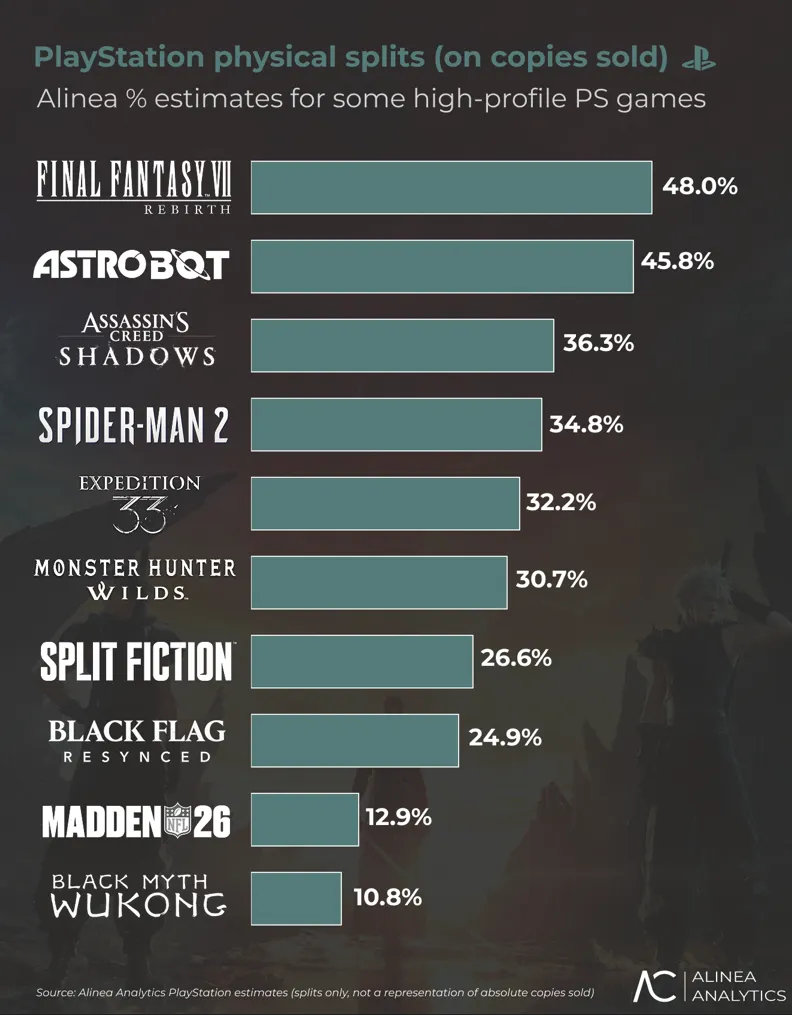
Alinea Analytics also revealed its estimated splits between physical and digital sales across ten of the most high-profile PlayStation games in recent years.
The data is surprising, as the splits vary wildly depending on the game.
The Final Fantasy VII remake, for example, saw 48% of all sales – nearly half – being physical copies.
Astrobot also saw over 45% of all sales being physical copies, while titles like Assassin’s Creed Shadows, Spiderman 2, Expedition 33, and Monster Hunter Wilds all sold over 30% of all copies in physical form.
In contrast, however, the splits of games like Madden 26 and Black Myth Wukong were much more lopsided towards digital.
Madden 26 sold only 12.9% of all copies in physical form, while for Black Myth Wukong, the percentage dropped to only 10.8%.
“The top of the list is collector territory, the prestige single-player epics (FF7 Rebirth, Astro Bot, Spider-Man 2, Expedition 33) that we older heads want sitting on our shelves,” said Elliott.
“Then, the bottom belongs to digital natives like Black Myth: Wukong (a PC-first title with a massive China audience used to digital downloads) and Madden 26 (an annual live-service game nobody keeps a box for).”






 Loading ...