

AMD recently revealed a few key features about their next-generation graphics family during an interview with Forbes. The company will continue to use the 28nm process for the GPUs and will price them more effectively.
AMD general manager of the graphics business unit, Matt Skynner said that the company was not targeting super-high prices or competing in the $999 price range just yet, as they didn’t think it was realistic for a product launch.
“We’re not targeting a $999 single GPU solution like our competition because we believe not a lot of people have that $999. We normally address what we call the ultra-enthusiast segment with a dual-GPU offering like the 7990. So this next-generation line is targeting more of the enthusiast market versus the ultra-enthusiast one,” said Skynner.

AMD’s Radeon HD7990 previously was at the $999 price point, but has been lowered to around $700.
Skynner also noted that the next generation of GPUs would be on the 28nm process instead of the more advanced 20nm process. He said that AMD can target higher clock speeds and more efficiency with a more mature production process that had guaranteed yields.
On the subject of efficiency, Skynner revealed that AMD was working hard to compete with Nvidia’s efficient Kepler graphics family. “Our design is also extremely efficient. GK110 is nearly 30% bigger from a die size point of view. We believe we have the best performance for the die size for the enthusiast GPU,” he said.
AMD’s drivers and software have been improving greatly over the past year, much to the delight of gamers and users that may have had issues in the past with technologies like Eyefinity and frame pacing. Skynner revealed that AMD was working on a similar application to rival Nvidia’s Geforce Experience, but could not reveal any further details.
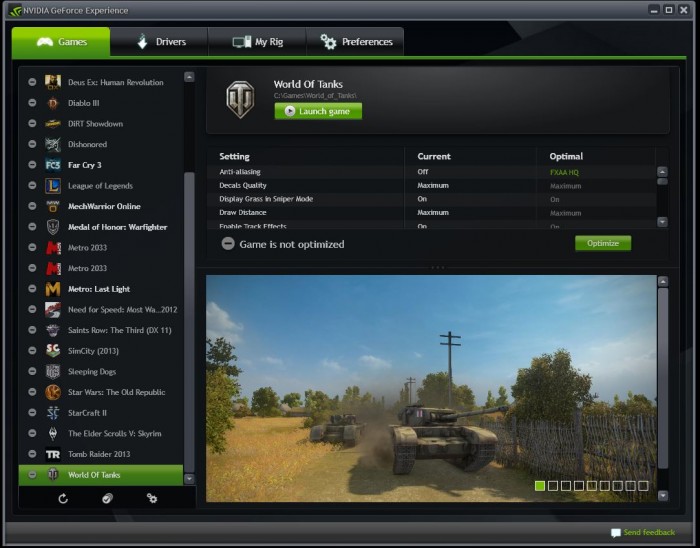
Nvidia Geforce experience application
“We were doing driver updates monthly whether we needed to or not. The frequency of our updates – especially lately – I’d say is pretty good. We have a plan to release a new driver when a significant new game becomes available.”
This is in contrast to an announcement AMD made last year when they split driver development for their graphics cards, putting models from the HD4000 and older families into “legacy driver” status in order to concentrate on improvements for the HD5000 and newer series.
At the same time, AMD also announced that drivers wouldn’t be updated as frequently and that updates would be rolled into Catalyst releases that would only be available three to six months apart.
AMD will be holding a conference in Hawaii on 25 September to announce the way forward for the company in 2014 and possibly announce new graphics cards, more details on their Kaveri APUs and the future for the AM3+ desktop socket.
Source: Forbes
More Hardware news:
New AMD GPU naming scheme explained
DDR4 RAM: the market isn’t ready
AMD processors SA pricing roundup
Gigabyte Brix with Intel Iris Pro Graphics: powerful gaming PC fits in your hand






 Loading ...