

DieGrootHammer
Daddy TK
Our microtransaction talk is continuing with the biggest reason anyone gives as to why microtransactions are in a game. Cost of game development has increased over the years with the price of games staying at $60. Surely it stands to reason that publishers needs lootboxes to keep the lights on. For a long while now, this has been my biggest point that I've made. Until now...
You see it's financial statement season, with plenty of publishers publicly showcasing their financial positions for their fiscal year 2016/2017. And it makes for really interesting reading. Well, interesting to me, and there are a lot of points to make from these statements. So lets look at some charts, shall we?
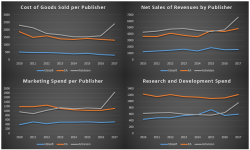
I looked at these 4 key areas in the financials of the 3 biggest publishers, Activision Blizzard, EA, and Ubisoft. These reports have been really interesting to read, but there are a lot of damning evidence in all of them. Also, Activision Blizzard's spike in 2017 is due to the aquisition of King having an impact in their financial statements, and will be ignored for our purposes, as it dilutes the issue.
For starters, these graphs clearly show that, these top 3 publishers are not spending huge amounts more on R&D, and in fact across the board COGS is coming down. This was really interesting to me. All three list the impact of digital sales as one of the biggest drivers to lower COGS. What they fail to show is that all 3 of them are releasing much less games per year than ever before.
Another point to make is that where we always thought the marketing budgets of these games are getting out of hand, it's clear that the overall spending on marketing has not increased to that extent for these publisher. All the while profits are increasing, in some cases in double digits.
So there are a few notes that I would like to make about this information:
1. Games may be increasing on cost for individual titles, but their costs are mitigated by Publishers just releasing less games. Less games equals less cost. It's why EA had such a boring E3 presence, they literally don't have anything to show.
2. Marketing spend is not "getting out of hand" and increasing the cost of development. In fact, with less games being released, each individual title can get a bigger slice of the marketing pie
3. All 3 Publishers showed a profit, even if you disregard income generated from microtransactions. They have carefully crafted their businesses to such an extend that they do indeed turn a profit for the year, even if some games failed dismally.
So, in conclusion, yes, individual games are increasing on cost, but these publishers are big businesses, and run as such. Which means they will just release less games and effectvely decrease overall cost and higher profit margins.
You see it's financial statement season, with plenty of publishers publicly showcasing their financial positions for their fiscal year 2016/2017. And it makes for really interesting reading. Well, interesting to me, and there are a lot of points to make from these statements. So lets look at some charts, shall we?
I looked at these 4 key areas in the financials of the 3 biggest publishers, Activision Blizzard, EA, and Ubisoft. These reports have been really interesting to read, but there are a lot of damning evidence in all of them. Also, Activision Blizzard's spike in 2017 is due to the aquisition of King having an impact in their financial statements, and will be ignored for our purposes, as it dilutes the issue.
For starters, these graphs clearly show that, these top 3 publishers are not spending huge amounts more on R&D, and in fact across the board COGS is coming down. This was really interesting to me. All three list the impact of digital sales as one of the biggest drivers to lower COGS. What they fail to show is that all 3 of them are releasing much less games per year than ever before.
Another point to make is that where we always thought the marketing budgets of these games are getting out of hand, it's clear that the overall spending on marketing has not increased to that extent for these publisher. All the while profits are increasing, in some cases in double digits.
So there are a few notes that I would like to make about this information:
1. Games may be increasing on cost for individual titles, but their costs are mitigated by Publishers just releasing less games. Less games equals less cost. It's why EA had such a boring E3 presence, they literally don't have anything to show.
2. Marketing spend is not "getting out of hand" and increasing the cost of development. In fact, with less games being released, each individual title can get a bigger slice of the marketing pie
3. All 3 Publishers showed a profit, even if you disregard income generated from microtransactions. They have carefully crafted their businesses to such an extend that they do indeed turn a profit for the year, even if some games failed dismally.
So, in conclusion, yes, individual games are increasing on cost, but these publishers are big businesses, and run as such. Which means they will just release less games and effectvely decrease overall cost and higher profit margins.


