The team stops to plan its approach - a scripted moment that Tung can either choose to observe or ignore. But the buildings, which are far more plausible domestic spaces than we've seen in previous Halo games, are completely deserted - whatever caused the damage has now gone.
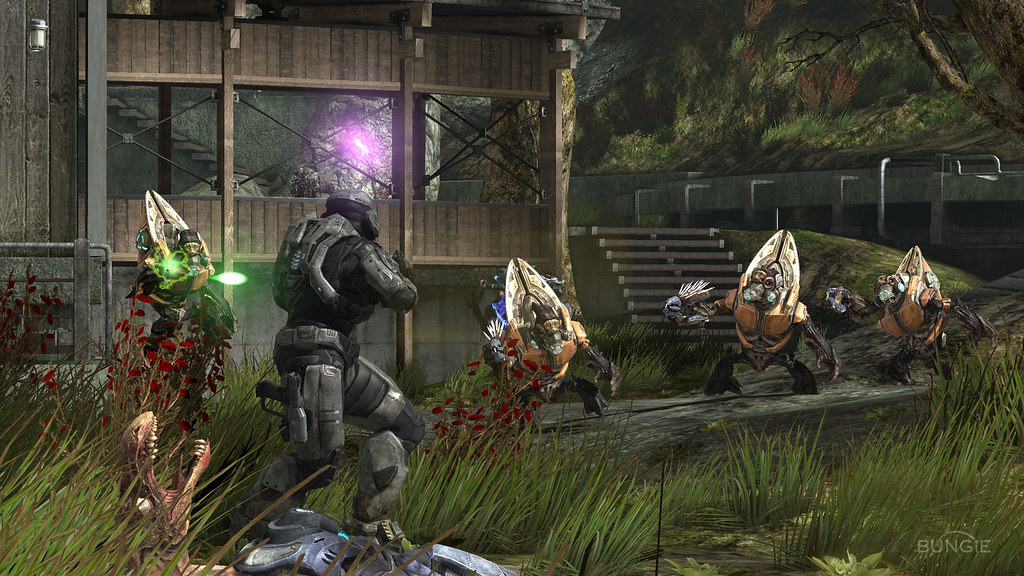
The level moves on through another homestead, where we find the bloody remains of some unlucky troopers, and soon after, their terrified officer on the upper floor, looking out over a courtyard and scrubby pasture beyond. And, with a burst of green plasma fire and the appearance of a new enemy, the first battle begins.
The attackers are Skirmishers, small and fast, with a similar birdlike countenance to the Jackal but with a ruff of feathers and a far more aggressive disposition. Tung shoots back with his assault rifle, but they're too fast for him to drop a single one before they make it inside the building.
For a game's first battle, the encounter is intense, and it's not just down to the Skirmishers' speed and ferocity. The newly beefed-up sound effects for the weaponry provide an additional visceral punch over previous Halos - not that the assault rifle's satisfying chatter used to be a problem, but now it sounds like it'd really tear through flesh. The plasma pistol, too, has received a power-up - its charged shots now explode in a much angrier flash of fizzing energy.
Shock tactics
It's all part of another ambition Bungie has for Reach - giving it a more sombre and serious tone than its forebears. "We wanted to reintroduce a more terrifying Covenant," says Tung. The Grunts won't squeal comically any more, and the only English you'll hear from your enemies will be jeers and insults. Though Covenant style is as colourful as ever, it's intended to emphasise its alien nature.
"We wanted, especially with Covenant weaponry, something much more violent and visceral," continues Lehto. And then there's the triumphant reappearance of the Elites, who (this is a prequel to Combat Evolved, remember), will reintroduce a certain class and finesse to the battles that the thuggishness of Halo 2 and 3's Brutes had eroded.
But if you're fearing the loss of the classic Halo combat - of flowing assault and retreat, that special balance of gunmanship and grenades, of an open warriors' playground - you've absolutely nothing to fear. As Tung finally makes his way outside, a Spirit dropship - the one seen in Combat Evolved, which Bungie affectionately calls the 'tuning fork' - appears and unloads a cohort of Grunts while its turret rains purple fire on him. As he works his way between cover in the form of the large strewn boulders studding the wide pasture, it's clear that Bungie hasn't changed anything about that core, essential Halo experience.
Oh, except one significant thing. Though each of the fights in the two missions we see - the first and third of the game - feature the numbers of enemies we're used to, other battles will be much, much larger. Bungie's plucky engineers have doubled the number of enemies and allies that can be active at any time, from Halo 3's 20 to around 40. And that's not counting some tweaks to the engine which will allow the game to simulate distant battles that are taking place.
As you near them, the characters will switch from scripted behaviours into fully active AI. According to the campaign's lead designer, Chris Opdahl, "It does feel like there's this world on fire, and that you're part of the battle." An idea of what we can expect is presented by the end of the first mission, an extended raid by the Covenant on a military base.
It's so fierce that Noble Team is forced to retreat into the building, with Tung furiously fighting the attackers back until his squadmates can get the blast doors closed.
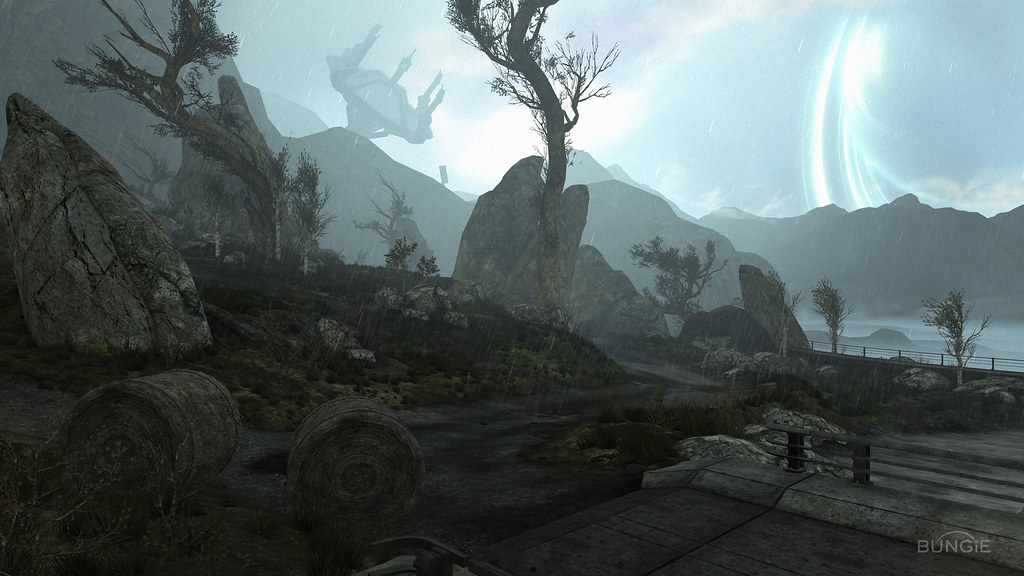
Another benefit to Reach's new tech is larger levels - not so much in sheer real estate but in scope. The first mission isn't the wide corridor on which later Halo games have been based - Opdahl and his team have looked back to Combat Evolved and the epic breadth offered by such classics as Silent Cartographer, in which objectives were set off branches from its wide, sandy beach, and the immense size of Flawless Cowboy. Mission one's homesteads are set on a simple network of mountain paths which you can explore in the order you wish - it's even up to you whether you want to scour each building.
The scale of the levels will also allow co-op to be more flexible and fun. The teleporting, which would keep players close together in all the earlier games, will be far less strict. This, combined with some exceptionally long vistas, means you'll be able to see your friends battle across the map while you can take your own foes on.
Mixing it up
The level designers have also looked to Silent Cartographer's flowing mix of vehicle and on-foot action. "I think the strongest missions in all three Halo games have been the ones where you're on foot, then you find a vehicle and then there's some reason to get out and do something new before returning to it," says Opdahl. "We've embraced that - get a vehicle, waste as many enemies as possible, and then more tense on-foot close combat sections."
The technology which has enabled all of this is also behind the much more elaborately detailed environments and character models, which will feature more variety than ever seen before. It extends from your colourful Spartan friends to the Marines who will be fighting alongside you ("The Halo 3 Marine was nothing to write home about, so that was a serious kick in our pants to do something better," admits Lehto), and the various castes and creeds of enemies. The fast pace means it'll take Theater Mode to appreciate it, but it's always good to know it's there.
Not that Reach won't allow you to get up close and personal with the Covenant, as shown by the second mission we see. The third mission of the game, it takes place on a rainy night with just Tung and Jun, the sniper, raiding a Covenant-occupied human base in order to assess the extent of the invasion. With Jun taking position on a rocky outcrop overlooking the level, Tung works his way in, showing off Reach's new assassination move - an animation that snaps the view into third-person when you hold the melee button behind an enemy so you can see your Spartan smoothly take them down. Though Bungie's not fixed on it, it's quite likely this will replace the standard melee in both single- and multiplayer.
The level also demonstrates a major tweak the team has made to Halo 3's equipment. Knowing that players tended to horde equipment like the active camo and bubble shield because they were one-off use only, armour abilities - as they're now called - will allow you to use them as many times as you like, with each use separated by a brief cooldown period. The first we see during the first mission is dash, a sprint that lasts a few seconds. The second, useful for Tung's stealthy approach to mission three, is active camo, which allows him to take out a patrol before melting away to take on another on the other side of the base. In multiplayer, the camo will also deaden sounds (good for snipers) and cause red dots to appear on nearby players' radars. Though they'll have a hard time tracking you, they'll also know you're around...
Worlds apart
Bungie is keen to impress upon us that Reach is not Halo 4. It's not a continuation of its story; setting it before Combat Evolved has actually given Bungie much freedom to chop and change weaponry and war materials with the excuse that it was superseded by more advanced models later on. It could also introduce such new enemies as Skirmishers and fit them into Halo's lore with the explanation that the vast extent of the battle and destruction of the planet caused their extinction.
As such, Reach has style and poise that's very much its own. But it's also the direct result of all the studio's work on the series. "Halo Reach is probably the most powerful title we've built to date with regards to story, character, new gameplay features we're throwing at the player, and new experiences overall," Lehto is keen to stress.
Though the screenshots all look unmistakably Halo-like, the smart refinements Bungie has so far revealed for its exit from Halo means it's more than likely that Reach will be the best game it's released yet. How is Bungie ending its work on the series? By going full circle, it's ensuring it's going out with the biggest bang.




 recently got ODST but haven't had the time to touch it... really looking forward to Reach though

