How much electricity your consoles use and what they cost you

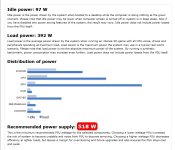
For PC, using this site http://powersupplycalculator.net/

I Get Idle ~100w, Load ~460w

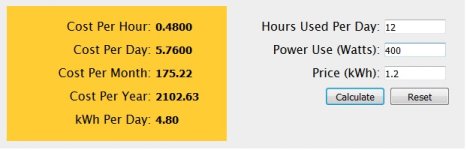
So lets take 3 hours gaming, 1 hour idle per day. Simplifying things a bit, this gives me 1480w used per day. 1.48kW x R1.20 (price per kW) = R1,78 per day.
R1,78 x 365 = ~R650 per year.

Not cheap belonging to the master race.
 
Quick calc on my setup.

psu.jpg

powerconsumed.jpg

Probably half that though. The PC idles more than half that time period.
 
That's actually a lot of money. I wonder how much my pc uses.

Was wondering exactly the same. Actually scared to see. guess they can't really work that out, as pc components differ so much
I've done this exercise, I have a digital watt meter.

My pc uses 120W idle and 420W with a benchmark that pushes it to the max. When playing a game it uses about 250W (depends on the game).

This is for an i5 2500K @ 4.5ghz
P67 Motherboard
GTX 980
2 x 24" led screens
4 hdd's and 1 ssd
All the fans, peripherals and headphones

I don't think it is all that bad
 
my ps3, tv, media pc and soundbar are all plugged into a 2000VA UPS (input voltage rating around 140-300VAC).
No idea how to convert that to kw/h

At least it keeps going with the frequent power failures at my house till the generator is plugged in (plot life) :)
 
PC wise Its not that bad, I mean do an equivalency, a slice of toast and few cups of tea at best per day
 
my ps3, tv, media pc and soundbar are all plugged into a 2000VA UPS (input voltage rating around 140-300VAC).
No idea how to convert that to kw/h

At least it keeps going with the frequent power failures at my house till the generator is plugged in (plot life) :)

1 VA == 1 Volt Ampere == 1 Watt (Power = Voltage x Current) if you're in single phase (which you are) and you ignore efficiency and power conversion losses (which you can't). If you take the inefficiencies and conversions into account, you'll get something like 0.6 Watt for every VA. This is you maximum power draw. I hesitate to use analogies with you, because it proved really ineffective with you the last time I did, but think of this as how big you can open your tap.

This does not speak to the power capacity of the battery in your UPS. This is typically measured in Ah (Ampere-hours) for UPS's, and mAh for power banks and cellphone batteries. Think of this as how big a dam your water tap is connected to, or more correctly, the amount of energy stored.

In order to get to kWh (Note that it's kiloWatt-hours, not kiloWatts per hour, which is also a measure of energy), you'd time how long it takes (say 0.5 hours) to use your entire battery's power store (say, 10 Ah). Multiply this by the supply voltage, 220V (because Power P = Voltage V x Current A) and you get 1100 Wh, or 1.1kWh. Multiply by your local electricity cost in R/kWh to get your cost for 1 UPS worth of power.

To get your average power draw, take the kWh you got in the previous section, and divide by the time it took - 1.1kWh / 0.5 h = 2.2 kW. Which is really high, but I did suck those numbers out of thin air, so that is to be expected :D
 
1 VA == 1 Volt Ampere == 1 Watt (Power = Voltage x Current) if you're in single phase (which you are) and you ignore efficiency and power conversion losses (which you can't). If you take the inefficiencies and conversions into account, you'll get something like 0.6 Watt for every VA. This is you maximum power draw. I hesitate to use analogies with you, because it proved really ineffective with you the last time I did, but think of this as how big you can open your tap.

This does not speak to the power capacity of the battery in your UPS. This is typically measured in Ah (Ampere-hours) for UPS's, and mAh for power banks and cellphone batteries. Think of this as how big a dam your water tap is connected to, or more correctly, the amount of energy stored.

In order to get to kWh (Note that it's kiloWatt-hours, not kiloWatts per hour, which is also a measure of energy), you'd time how long it takes (say 0.5 hours) to use your entire battery's power store (say, 10 Ah). Multiply this by the supply voltage, 220V (because Power P = Voltage V x Current A) and you get 1100 Wh, or 1.1kWh. Multiply by your local electricity cost in R/kWh to get your cost for 1 UPS worth of power.

To get your average power draw, take the kWh you got in the previous section, and divide by the time it took - 1.1kWh / 0.5 h = 2.2 kW. Which is really high, but I did suck those numbers out of thin air, so that is to be expected :D

When my ups is drawing maximum load (all above equipment and an 11watt cfl) it lasts around 40 minutes till the battery goes completely flat.

It is also always plugged in, no idea what power it draws when it is in standby mode though, I know that it is still drawing power as the fans still run.

Anyway, likely a ton more power than all the equipment would use if plugged in separately but worth the cost with the quality of power we have.
 
When my ups is drawing maximum load (all above equipment and an 11watt cfl) it lasts around 40 minutes till the battery goes completely flat.

It is also always plugged in, no idea what power it draws when it is in standby mode though, I know that it is still drawing power as the fans still run.

Anyway, likely a ton more power than all the equipment would use if plugged in separately but worth the cost with the quality of power we have.

When your UPS is providing maximum load it lasts 40 minutes. Without knowing what capacity battery you have in there, there's not much we can deduce from that, though.

The difference in power consumption between using the UPS and not using it largely comes down to the losses going from VA to W. This should be noted in the UPS manual, but in all likelihood it'll be around 1 VA = 0.6 W, so 1W == 1.667 VA. That is, power provided by the UPS is about 66 % more expensive than from the wall.
 
When your UPS is providing maximum load it lasts 40 minutes. Without knowing what capacity battery you have in there, there's not much we can deduce from that, though.

The difference in power consumption between using the UPS and not using it largely comes down to the losses going from VA to W. This should be noted in the UPS manual, but in all likelihood it'll be around 1 VA = 0.6 W, so 1W == 1.667 VA. That is, power provided by the UPS is about 66 % more expensive than from the wall.

It's 2x 12v/45w batteries in parallel :)

2000va gives around 1200w peak load but I don't run anywhere near that, Media pc with a (ehrm cheapie :D ) 450w psu (4x3tb, 1x 1tb hard drives, old nvidia 9600gpu), 300w sound bar (about 50w max usage), ps3 and a 40" lcd tv. The cfl only goes on if the power goes off at night so that there is some light in the room till the generator gets plugged in.
 
Back
Top