New range of MSI notebooks

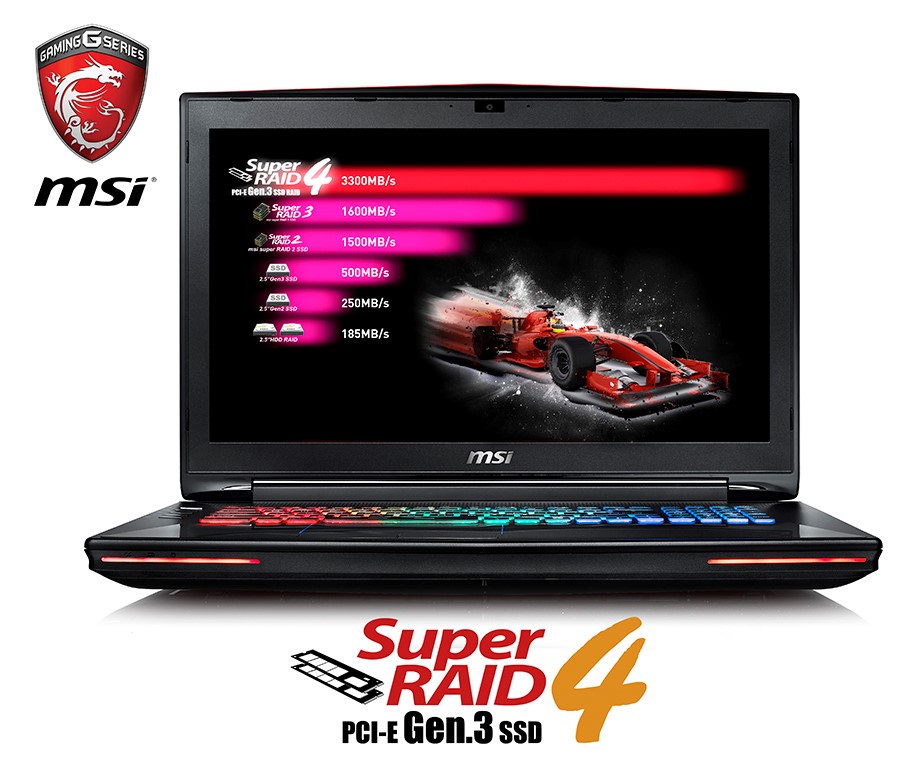
Super RAID 4

Super RAID has since its first incarnation been at the forefront of storage transfer speeds – starting with peak transfer speeds of around 800MB/s with two SSDs in RAID0. As SSD technology has improved, transfer speeds have gone up, and the ability to package several SSDs into one system has also become possible. This led to the developments Super RAID 2 and 3, both available in our current lineup of notebooks.

Basically, Super RAID 2 is three mSATA SSDs in a RAID0 array, and Super RAID 3 is an additional SSD on top of that, still RAID0.
This has yielded transfer speeds in excess of 1500MB/s or 1.5GB/s – this means for instance that you can open your applications instantaneously and that your in-game maps will load lightning fast. However, we’re not ones to rest on our laurels – having long had the fastest storage solutions, used in both our Gaming systems as well as our Workstations, we’ve taken the opportunity to introduce Super RAID 4 with our new refreshed notebooks – for even higher, slightly dizzying, transfer speeds of up to 3300MB/s – over 3GB/s.

9de32b3b_o.jpeg


Super RAID 4 consists of two PCI-E 3.0-based NVMe SSDs in RAID0 and is available on the Skylake-equipped versions of the Gaming systems GT72 and GT80.
 
DDR4 benefits
The launch of Intel’s new mobile 6th Gen Core CPU family has brought along a bunch of changes – of course we will see the usual barrage of small improvements in gaming performance and power consumption, but it’s also a paradigm shift. For the first time in a very long time, we’re seeing a shift in memory technology, going from DDR3L to DDR4.

First of all, unlike the shift from DDR2 to DDR3, there is not a huge price premium to pay as a consumer – pricing on DDR4 technology is already made affordable by desktop systems and competition among DRAM manufacturers – meaning it’s surprisingly affordable to be an early adopter this time around.

Of course, it’s not a change just for the heck of it – DDR4 is going to be the memory standard to be reckoned with for years to come, meaning it makes sense to go for a DDR4 platform if you want to add more RAM. Maybe most importantly, the performance is obviously also up – frequencies are higher, and while timings are seemingly more relaxed, overall latencies are significantly lower.

9de32b3b_o.jpeg


The result of this is plan to see in our graph above – going from DDR3L at 1600MHz (which is the standard speed used in MSI Gaming systems) to DDR4 at 2133MHz gives improvements in the neigbourhood of 35% on average. The benefits of this vary from application to application, but a lot of compression software relies on high memory performance, as do certain games. One thing that is clear is that it will improve your productivity, even in daily tasks.

To secure a system that comes with the memory of the future, look out for systems with the 6th Generation Core CPUs from Intel, available in our Gaming lineup of notebooks.
 
Case Study: Jacques de Vos and the WS60

Our mobile Workstation systems are perhaps not highlighted as often as our Gaming systems, but they definitely deserve some love as well. With mobile NVIDIA Quadro graphics, they’re the perfect tool for CAD/CAM and simulation software, but truth is that they also give a nice boost in the Adobe Creative Cloud suite. We’ve been working with underwater photographer Jacques de Vos to come up with a case study, take a look at how he uses the WS60 in the video below.

 
PX60 Video

Our P-series of notebooks is a very versatile series of machines. While the G-series focuses solely on gaming, and the W-series comprises of mobile workstations, the P-series is aimed at a professional audience that doesn’t necessarily need workstation-grade graphics.

The PX60 is actually fairly similar to the GS60, but is improved with a screen panel calibrated to 100% sRGB, featuring True Color technology. This is so you can edit images and video with sure-fire knowledge that your colors are exactly as they should be. It obviously also helps when watching movies, and for that the PX60 is using the same Dynaudio sound system as its G-series sibling.
The CPUs used are the same – Broadwell and Skylake options are available, Super RAID, USB 3.0 Type-C, and of course NVIDIA Graphics. In this case, the graphics used are a notch below what you would normally find in the GS60, the PX60 uses GeForce GTX 950M and 960M.

Have a look at what you can do with the PX60 below.

 
MGA Highlights

Each year, we host a large e-sports tournament – you may have heard of this previously, under its Beat It moniker. For 2015 though, it’s been renamed Masters Gaming Arena, or MGA for short. The finals were held in Seattle in August, with a prize pool of $250,000 USD.

In case you missed it, check out the event highlights below.

 
Back
Top