

GregRedd
New member
Happy Easter MyGamers!

I grew up in a pretty staunch Catholic home. As a kid, Easter Sunday was always a pretty exciting morning, probably second only to Christmas morning. Yeah, I knew I'd have to go to a long, boring, heard-it-all-last-year mass soon, but the thrill of hunting for chocolate eggs in the brisk, chill of an early Autumn morning before that was always fun.
My Catholicism has long since lapsed, but ever since those youthful days I've been curious about symbolism and the origins of them. Christian Easter is filled with symbolism, rabbits and eggs being the most obvious.
The egg I always understood to represent fertility, rebirth, the start of new life. But the story behind the Easter rabbit was never really made clear in any of those post-mass Catechism classes that the grumpy Irish nuns gave us as kids. I mean, why rabbits? And why rabbits delivering eggs? It made no sense. Surely a chicken egg delivery service would be more logical? Especially because there's a bit somewhere in the Bible that suggests that "the hare is an unclean animal". (Paraphrased. I'll find the precise quote if you really want.)
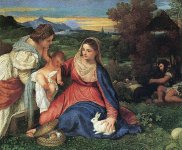
Years later I discovered that rabbits and hares regularly featured in Christian art, frequently alongside Mary. Art History studies in High School taught me more than just that Andy Warhol was a really trippy dude. In Christian art, the rabbit was associated with rebirth and resurrection, with purity and virginity, and more obviously to me, with fertility - "breed like rabbits", anyone?
Titian's "The Madonna of the Rabbit" is one of the paintings I had to study in those days:
A lot of the bunny association to Easter is thought to have originated in Saxon-Germanic pagan customs. In the pagan Wheel of the Year, the vernal equinox is marked at this time with the festival of Ostara.
A couple of centuries later, and German immigrants to the US took the custom of the Easter Bunny with them to their new home, and pretty soon after, the confection and sweet shops of New York and Boston were selling bunny shaped sweets, which subsequently evolved into the tradition of chocolate rabbits that we have today.
So there you go. Now you have a couple of conversation starters for around the Easter lunch table this afternoon
Happy bunny day y'all!
I grew up in a pretty staunch Catholic home. As a kid, Easter Sunday was always a pretty exciting morning, probably second only to Christmas morning. Yeah, I knew I'd have to go to a long, boring, heard-it-all-last-year mass soon, but the thrill of hunting for chocolate eggs in the brisk, chill of an early Autumn morning before that was always fun.
My Catholicism has long since lapsed, but ever since those youthful days I've been curious about symbolism and the origins of them. Christian Easter is filled with symbolism, rabbits and eggs being the most obvious.
The egg I always understood to represent fertility, rebirth, the start of new life. But the story behind the Easter rabbit was never really made clear in any of those post-mass Catechism classes that the grumpy Irish nuns gave us as kids. I mean, why rabbits? And why rabbits delivering eggs? It made no sense. Surely a chicken egg delivery service would be more logical? Especially because there's a bit somewhere in the Bible that suggests that "the hare is an unclean animal". (Paraphrased. I'll find the precise quote if you really want.)
Years later I discovered that rabbits and hares regularly featured in Christian art, frequently alongside Mary. Art History studies in High School taught me more than just that Andy Warhol was a really trippy dude. In Christian art, the rabbit was associated with rebirth and resurrection, with purity and virginity, and more obviously to me, with fertility - "breed like rabbits", anyone?
Titian's "The Madonna of the Rabbit" is one of the paintings I had to study in those days:
A lot of the bunny association to Easter is thought to have originated in Saxon-Germanic pagan customs. In the pagan Wheel of the Year, the vernal equinox is marked at this time with the festival of Ostara.
The vernal equinox, in Germanic traditions often called Ostara, a word invented by Grimm in the 1840s, inaugurates the new year on the Zodiacal calendar. From this point on, days are longer than the nights. Many mythologies regard this as the time of rebirth or return for vegetation gods (e.g. Attis) and celebrate the spring equinox as a time of great fertility.
Egg decorating is a very common tradition in vernal equinox celebrations throughout Europe.
Germanic pagans dedicate the holiday to their fertility goddess Ostara (the eastern star). She is notably associated with the fecund symbols of the hare and egg. Her teutonic name may be etymological ancestor of the words east and Easter.
A couple of centuries later, and German immigrants to the US took the custom of the Easter Bunny with them to their new home, and pretty soon after, the confection and sweet shops of New York and Boston were selling bunny shaped sweets, which subsequently evolved into the tradition of chocolate rabbits that we have today.
So there you go. Now you have a couple of conversation starters for around the Easter lunch table this afternoon
Happy bunny day y'all!

