PC/Console Piracy vs Series/Movie Piracy

It's not the most perfect analogy, but if you couple it with the "pirates are likely to make more sales" then that's where the extra funding comes from. Besides, you have to remember that Games/Music are not the sole provider of income for these companies, one will support the other or they have investment revenue to help develop the game/record the music/film the movie.

A poll conducted right before the pirate bay trial, with a sample size of 2000 people. I highly doubt it's accuracy.

Why would anyone invest in a company that has no sales record? Cannot be audited, and is accountable to no one. You would get very poorly developed titles since there would be no funding for the product. How would sell a product to a bunch of investors saying we need $10 000 000 we can't put a price on the product, but at least people will enjoy it. Would you fund it?
 
It's not the most perfect analogy, but if you couple it with the "pirates are likely to make more sales" then that's where the extra funding comes from. Besides, you have to remember that Games/Music are not the sole provider of income for these companies, one will support the other or they have investment revenue to help develop the game/record the music/film the movie.

With music, there are many avenues of income (live performances, albums, singles, etc), same with series and film (cinema, DVD, TV licences and ratings). With games it's a lot more complicated: the only income is from people who buy.

Urgh... am I really involving myself in this now?

If you look at Wikipedia's List of Best-Selling Games you'll notice that simple games which appeal to the casual market have the biggest figures (we're talking tens of millions here). Look at Nintento, Wii, Gameboy. These are simple, easy-to-grasp games.

On the heavier consoles with a more 'hardcore' selection, the sales are significantly less. Now, personally, I'd take Dragon Age over Mario any day, but that's just me.

To me, this indicates that different games appeal to different markets. Casual gamers are much more likely to buy simple, gimmicky games than they are to storm off and spend the same amount of money on something like a PC and Dragon Age.

I don't believe that piracy has anywhere near as negative an impact as bureaucracies would like us to think and, for the most part, it may actually contribute to the industry as a whole.

I base this assertion on personal experience and on the simple fact that people who love games are the ones who buy them whether they've pirated them first or not. People who play games and don't buy them never would've bought them in the first place--much like that hippy friend everyone has who occasionally borrows your books or games but never buys any of their own because it's a passing fancy, not a devout love.

Look at JoWood filing for bankruptcy after their release of Gothic 4. They managed to keep their fandom through three games with the original developer (Piranha Bytes). Yet they tried to turn it into a simple and easily-accessible hack-and-slash which failed. They paid another developer 6,000,000 Euro. Piranha Bytes has done much more with significantly less resources, yet they have managed to always be successful (Gothic 1, 2, 3; Risen).

What does this tell you about people's likelihood to buy? People with no intention to buy your products are not your damned market.

It's also why I consider DRM futile and nothing short of victimisation of actual buyers.

Game developers have a tough and risky job, much more tough and much more risky than movie houses or musicians and my heart goes out to them. But blaming piracy for your own misgivings while simultaneously lambasting your customers (those folk who are on your side) with DRM, activation limits, account-locking and otherwise making their collections nothing short of a collection of paperweights is insulting. Not to pirates, to us.

I think it's difficult figuring out your market in any business, but game developers have it that much harder because with them, it's hit-or-miss and in three-to-six months their games go off the shelves and they're never heard of again unless they managed to take off.

Meeeh... :p
 
Last edited:
I don't believe that piracy has anywhere near as negative an impact as bureaucracies would like us to think and, for the most part, it may actually contribute to the industry as a whole.

I base this assertion on personal experience and on the simple fact that people who love games are the ones who buy them whether they've pirated them first or not. People who play games and don't buy them never would've bought them in the first place--much like that hippy friend everyone has who occasionally borrows your books or games but never buys any of their own because it's a passing fancy, not a devout love.

It's also why I consider DRM futile and nothing short of victimisation of actual buyers.

Game developers have a tough and risky job, much more tough and much more risky than movie houses or musicians and my heart goes out to them. But blaming piracy for your own misgivings while simultaneously lambasting your customers (those folk who are on your side) with DRM, activation limits, account-locking and otherwise making their collections nothing short of a collection of paperweights is insulting. Not to pirates, to us.

I think it's difficult figuring out your market in any business, but game developers have it that much harder because with them, it's hit-or-miss and in three-to-six months their games go off the shelves and they're never heard of again unless they managed to take off.

Meeeh... :p

I have to agree with you on the DRM subject, I absolutely hate it. When you rent a dvd and have to go through 10 minutes of video telling you to rent dvd's.

I bolded a statement you made there and this is one that has struck a cord with me for some time now. I'm going to try and put this into as nice words as I possibly can so forgive me if my point isn't conveyed as well as it should, i'l make a longer post about it in future...

Your statement applied to real world situations, for instance a restaurant. You have your dinner finished every single thing on your plate, then you say :"well I didn't enjoy it that much, I've had better I'm not paying". Would you condone such action?

Now as for the money part, you have a store and every single day 5 people come into your store and take a loaf of bread without paying for it. Now you have insurance, but according to this argument one should not claim for the bread since it's not a loss of income. The person wouldn't have paid for it anyway thus it's okay.

Now I know tangible products are extremely complicated to compare with digital products, but I just hope you could see what I was going for.

P.S one last example. we did this in economics way back. If your neighbour doesn't pay tax, should he still be allowed all the benefits of a taxpayer?
 
Your statement applied to real world situations, for instance a restaurant. You have your dinner finished every single thing on your plate, then you say :"well I didn't enjoy it that much, I've had better I'm not paying". Would you condone such action?

Problem with this analogy is that should your food be unsatisfactory (cold, frozen in the middle, off, sour, whatever), you would be entitled to a reimbursement. You have eaten at restaurants before, and received something unsatisfactory and complained, no? :p

Now as for the money part, you have a store and every single day 5 people come into your store and take a loaf of bread without paying for it. Now you have insurance, but according to this argument one should not claim for the bread since it's not a loss of income. The person wouldn't have paid for it anyway thus it's okay.

The problem with your analogy (and many fall into the same trap) is that copyright infringement isn't theft. Theft is taking someone's car without their permission. Copyright infringement is "cloning" the car--the only real crime in this exact scenario is that you have prevented that person from being able to sell you his car because you already have one just like it.

A game is dissimilar in the sense that you can copy it, sure, but is it new? Does it have a manual, a disc, a new-smell to it? Does it come with all the other awesome goodies? It sure as hell doesn't come with DRM.

Yes, some people don't care about that stuff and are happy just playing the game, but again, they aren't the market, they're the scavenger riff-raff.

What I mean to say though is that copyright infringement is right there if you even sell a game second-hand (developers don't see a cent from that), if you lend a game to a friend, if your friend even plays it on your PC, if your wife occasionally likes to play your copy of The Sims. It's all copyright infringement to one degree or another.

Now I know tangible products are extremely complicated to compare with digital products, but I just hope you could see what I was going for.
*shrug* You'd have to be a bit more clear, methinks, since I'm just doing the generic response thing right now.

P.S one last example. we did this in economics way back. If your neighbour doesn't pay tax, should he still be allowed all the benefits of a taxpayer?

Once again, as a tax-payer you are paying for a service (maintenance of your roads, public schools, waste disposal facilities, etc). Should he still be permitted the benefits? No. This still doesn't relate to copyright infringement, however. Chalk and cheese :x

Let me be clear: in an ideal world where every game was AAA and you'd pre-order it the moment it's available and there was no DRM and every game was bound to be excellent and you'd always have money every time to buy as many games as you like then yes, I would be 100% against piracy. The world, however, isn't ideal and as I said, for all the bad piracy is accused of, it is so often neglected to remember the good it does too. Insane, twisted comparisons are drawn and it is unfairly vilified while people like me are conveniently forgotten: people who consider themselves devout gamers, who have pirated out of curiosity and ended up falling in love and collecting like there's no tomorrow, people who have ended up supporting companies like Piranha Bytes and even 2D Boy (World of Goo) because of Piracy, not despite it.

I'm tired of the usual black-and-white nonsense surrounding it when, as I said, it's very much a grey area :)

I support piracy.
 
Last edited:
Reserved for response.

I'l get back to you on this one, don't want to just ramble want to think about what you are saying and respond with some thought. :D
 
Reserved for response.

I'l get back to you on this one, don't want to just ramble want to think about what you are saying and respond with some thought. :D

Take your time :p

I'm happy just to be able to express my thoughts freely without, "Swine! Criminal! Hypocrite! Bastard! Fiend!" being thrown around :p
 
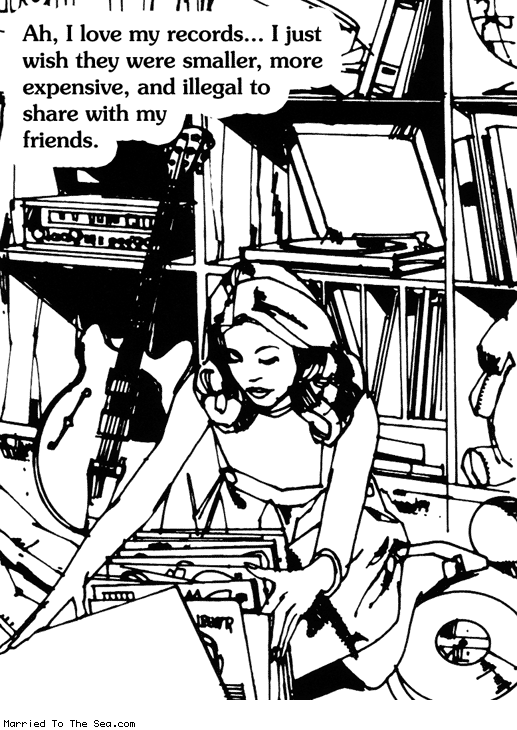
record-wishes.gif


:D I've gotten suckered into a bunch of comic strips and I'm liking 'em :o
 
Sorry, was watching an interesting program on DSTV which I haven't seen before. About the industrial revolution, quite informative, tells the whole story, BBC knowledge.

Will respond a bit later, but I do think DRM should FOADIAF. Why can't someone who downloaded a song from iTunes onto his/her iPod copy it back onto the PC? It's madness really. As well as with the requiring Internet to validate games thing, but that's for later.
 
Yes? My point is that I've never been required to pay an annual fee to my library. However, they do accept donations (financial and of books).

IIRC the libraries are run by local municipalities - up here in Pta you pay a small annual fee, I'm guessing down in Cpt you don't.
 
IIRC the libraries are run by local municipalities - up here in Pta you pay a small annual fee, I'm guessing down in Cpt you don't.

Well, I don't recall if the library I used to be part of in Cape Town was public of private but no, no annual fees. The Knysna public library (I'm in Knysna at the moment) hasn't any (at least none that I've noticed, and I'm pretty sure someone would ask :p).

Regardless, annual fees to the establishment or no, still doesn't contribute (financially) to authors and publishers. However, it does advertise remarkably well.
 
Back
Top