Power consumption: PC vs Console

BeoTeK

New member
I'm not trying to bait another pc vs console flame war thread, let's keep this civil please. I have a genuine interest in this and was wondering which uses more consumption. Now I run on prepaid electricity and just hoping that what's left in there needs to last me till payday and thus I have started thinking about this.

I have been using my console more and exclusively lately to try and save on power a bit more. But now I'm starting to wonder if I'm actually saving. Now off the bat I know my PS4 would obviously use less power than a my gaming PC, but let's looks at the grand scheme of things, what's needed to run both on high demand (ie during gaming).

Let's look at what may be approx avg in order to play games:

Console
PlayStation 4
40" or 46" LED LCD
Sound System
any peripherals and chargers

Computer
Quad core CPU
1000w PSU
Mid-range graphics card (GTX970 or R9 980)
2x Hard drives
all peripherlas
24" or 27" LED LCD


Now obviously I can't get exact numbers but just looking for approximates here and probably some better knowledge from anyone else out there that may know more than I do in this regard. I know for a fact that the PS4 uses less power, but as I said, in the grander scheme with all needed in order to play games, would they be on par?
Obviously I'm using some references from my setups, and I know I use almost 10kW per day when running my PC 24/7. BUt if we look further at a kWh rating, which would come out tops?

Some reference I have found.
PS4 Standby - 10 watts
PS4 Standby (Downloading) - 70 watts
PS4 Idle on Menu - 90 watts
PS4 Idle with Disc - 95 watts
PS4 Blue-Ray - 95 watts
PS4 Netflix - 93 watts
PS4 Game Install - 115 watts
PS4 Gaming - 130-150 watts
PS4 Charging Controller - Plus 4 watts

PS4 90-150 watts
Xbox One 70-120 watts
Wii U 35 watts
PS3 Slim 85 watts
PS3 Original 190 watts
Xbox 360 S 90 watts
Xbox 360 Original 180 watts
Wii 40 watts


Thoughts and opinions? Let the discussion begin.
 
I have always wondered the same thing and was tempted to buy one of those multiplugs with a LCD screen showing how much current is being drawn on the plug which should give you a proper estimation
 
This is actually very tricky to answer.

Looking at the PS4 setup first, and lets say both are in a gaming state.

Firstly, the type of TV is a big factor, as LED uses a lot less power than a Plasma, and a little bit less than LCD. For a 42" TV, LED uses 80W, LCD uses 120W and Plasma uses 220W (give or take a few Watts). I'm not sure if UHD draws more power than 1080p, but I think it would since more pixels have to be powered. Comparing two Samsung 40" TV's that are both smart TV's, both have 20W speakers, both LED, the UHD one draws 130W while the 1080p one draws 88W.

The second thing is the sound system. Do you use headphones, the TV's own speakers, a little DVD sound system or a big ass 7.1 setup? The power draw will range from 20W to 600W (or more). So once again difficult to determine.
The PS4 itself draws rather constant power during gaming (as you mentioned above [MENTION=4071]BeoTeK[/MENTION]), and also from what you gave the power draw for charging controllers is negligible for this comparison I think.

So a PS4 setup will draw 230W (PS4, small head/earphones, 42" LED) up to 970W (PS4, big sound system, 42" Plasma). We only end up with a range of power draw here which doesn't help. At the low end, definitely draws less power than your average gaming PC, at the top end it definitely draws more. People can perhaps post in this thread what setups they have and we can get an idea of power draw for the various systems?


Looking at the PC part, just as difficult. It depends highly on component selection here. Some people game on TV screens with their PC's and not gaming monitors, so determining power draw is once again a tough one, but for comparison's sake I'm going to use gaming monitors for PC.

A 24" LED Monitor draws between 25 and 40W. Let's say you have 2 monitors, so that is 50 - 80W.

For sound it also difficult. Using basic headphones, gaming headphones, PC speakers or Sound System? You will basically end up with the same type of power draw range here as with the PS4, so let's go with 20 - 600W.

Peripherals for PC also draw small amounts of power, since a USB port can deliver 2.5W max, so I will ignore them for PC as well.

Lastly, the components inside the case. This is the tricky part, but since we are comparing a gaming console to PC, I'll use the power draw for a PC with similar specs to the PS4 and then a more powerful PC.

Using http://www.extreme.outervision.com/PSUEngine and using components that closest compare to what the PS4 has, the power draw is about 350W.

For a higher end PC (single GPU) the power draw is more in the region of 600W, while you can go way higher than that with multiple GPU setups.

So a PC will draw from 420W (2 screens at 50W, cheap 20W earphones, 350W PC) up to 1280W (2 screens at 80W, 600W sound system, 600W PC). I know my PC draws around 600W (overclocked i5, GTX980, 4 HDD's, gaming headphones, 2 x 24" monitors).

It is really hard to try and assume everything low power consumption, and everything high. I'm sure people have a combo of low power PC components, but then perhaps game on a TV with a sound system.


I haven't owned a console since my SNES way back when, so I can't speak for the console guys, but I think in general console guys game with a sound system which really pushed up power draw.

TL;DR My view is that a lower end PC and even a decent gaming rig (I'll use my setup for reference here) will use about the same amount of power as a PS4 with a big TV and sound system.
Using a console and then headphones instead of a sound system will push down power draw by a lot and then the PS4 will definitely draw much less than the PC.

I hope this is coherent enough to follow, I've been typing it for the last 2 hours (keep getting interrupted) :/
 
Something else to consider is that when you game on Console, you have a pretty tight environment with few moving parts.

However the PC gaming environment can change a lot based on what all is happening in the background. Any serious gamer will shut down any unnecessary applications and processes, and make sure things like virus scans and program updates do not go off while gaming. But it still happens, especially over time as you install more and more things and slack off a bit on what all you control.

Even with the best intentions, you get people running something like uTorrent in the background when the company decides to bundle a bitcoin miner without people knowing, taking a huge hit on system resources and possibly power consumption.

It probably doesn't mean much in the grand scheme of things, but still something to consider.
 
Last edited:
Any kind of reasonably up to date gaming PC will use more juice than a console. The hardware is usually more powerful & not as specialised.

Obviously I'm using some references from my setups, and I know I use almost 10kW per day when running my PC 24/7.
Nope - thankfully not...that would be kark expensive. Thats what you'll end up with a single GPU decent sized gaming PC if the GFX is active 24/7. (Active being gaming, browsing etc won't kick a GFX out of its low power state). If its just switched on with some light browsing / movie watching it should clock in somewhere round the 2.5kW.

Its a little tempramental though. e.g. If you watch a movie that is in a codec that isn't hardware accelerated then suddenly thats a lot of heat & juice.

1280W (2 screens at 80W, 600W sound system, 600W PC)
I googled this a bit because it seemed odd - a sound system labelled 600W will probably not use anything close to that. Much like 1000W rated PSU doesn't automatically use 1000W. I gather a 600W sound system pushed to its limits will exceed 600W draw though due to inefficiencies. I'd imagine there are shtty Chinese systems that utilise 100% of their rated power even if on standby (like those shitty multichoice decoder - old ones at least).

For a higher end PC (single GPU) the power draw is more in the region of 600W
Seems a touch high. My 2012 era tech clocked in at like 450ish & everything should have gotten quite a bit more efficient since then.

On the whole I'm not really all that worried about the usage on my PC...its largely insignificant compared (mine idled at 100W) to the thingies that heat stuff (kettle, oven, geyser, heater etc). If you factor in how much utility (usefulness) I get from it then thats OK.
 
Last edited:
Obviously I'm using some references from my setups, and I know I use almost 10kW per day when running my PC 24/7. BUt if we look further at a kWh rating, which would come out tops?

I remembered that I read this, but forgot to comment. You meant that you use 10 kWh per day. In other words, you average power use was 1 kW for 10 hours, or 2 kW for 5 hours, etc.

10 kW refers to "instantaneous" usage, as it is 10 kJ/s (kilojoules per second). So a 2000W kettle, boiling for 2 minutes (let us assume constant 2000W usage during this time) will result in 0.067 kWh used.

I think the best comparison between systems will be kWh, as watt rating is just power draw at a point, but without recording data, comparing kWh will be near impossible.

Any kind of reasonably up to date gaming PC will use more juice than a console. The hardware is usually more powerful & not as specialised.


Nope - thankfully not...that would be kark expensive. Thats what you'll end up with a single GPU decent sized gaming PC if the GFX is active 24/7. (Active being gaming, browsing etc won't kick a GFX out of its low power state). If its just switched on with some light browsing / movie watching it should clock in somewhere round the 2.5kW.

Its a little tempramental though. e.g. If you watch a movie that is in a codec that isn't hardware accelerated then suddenly thats a lot of heat & juice.


I googled this a bit because it seemed odd - a sound system labelled 600W will probably not use anything close to that. Much like 1000W rated PSU doesn't automatically use 1000W. I gather a 600W sound system pushed to its limits will exceed 600W draw though due to inefficiencies. I'd imagine there are shtty Chinese systems that utilise 100% of their rated power even if on standby (like those shitty multichoice decoder - old ones at least).


Seems a touch high. My 2012 era tech clocked in at like 450ish & everything should have gotten quite a bit more efficient since then.

On the whole I'm not really all that worried about the usage on my PC...its largely insignificant compared (mine idled at 100W) to the thingies that heat stuff (kettle, oven, geyser, heater etc). If you factor in how much utility (usefulness) I get from it then thats OK.

I was thinking more in line with a 7.2 type sound system, those are 1500+W. Obviously I have no idea what kind of power draw you would have at say 30% volume, so I just spitballed 600W power draw. I didn't mean it is a 600W sound system.

I included speakers and monitors in that 600W for the high end PC, not just the case itself. :)

But yeah, quantifying how much a PC uses in a day is difficult, because you won't game the whole time, you'll browse, watch a video, etc. which does not draw a lot of power.
While with a console (depending on why you got it) you will mostly be gaming I guess, however I'm sure it gets used as a media centre as well.
 
Well this thread helped the time to pass (excuse the pun) while on the bog, so thanks chaps!

My machine is practically on 24/7. Plex tv + new born = watching episodes at funky hours. When my machine is just idling I think it uses something like 200w (don't know if that's per second or what. I base this off the pull I see on my UPS software) and under load its around 650w.
 
Isn't there some way I could measure this? If I take a multimeter, where would I measure from to check how much it's pulling?


I'll also check the prepaid meter this evening to see what it's measuring. Thanks again for all the information, very interesting.
 
Isn't there some way I could measure this? If I take a multimeter, where would I measure from to check how much it's pulling?


I'll also check the prepaid meter this evening to see what it's measuring. Thanks again for all the information, very interesting.

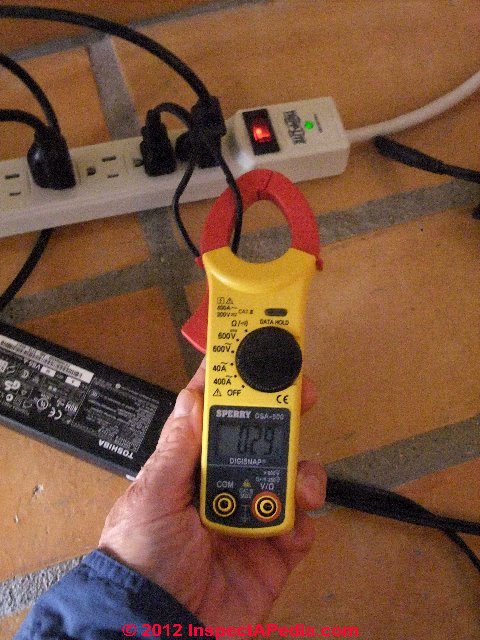
Most multimeters can't measure Power usage (Watts) but they can measure current (Amps). With measuring Amps the meter will need to be in series with the PC, like so:
F1SBENAH5IRWGVK.MEDIUM.jpg

This means cutting some power cable.

The other option is a Amp-Clamp that will not require cutting wires, but you will need to separate them as you only measure across one wire. Either live or neutral. Like so:
Digisnap_Meter_DSA-500_0117_DJFs.jpg

Measuring across both wires will give inaccurate readings as the two wires will cancel each other out.

When you have the Amp value simply multiply by 220 the get Watts at that specific moment. Try get an average to use for calculation.

Then Average Watts in KW x number of hours used = Units of power used.

Example:

You game for 8 hours and you measure 2.1A average to your PC

2.1 x 220 = 462W = 0.462KW

0.462 x 8 hour = 3.696 units used.

This is not taking things like power factor into account that reduces efficiency, but it's close enough.

Edit: When using a multimeter in option 1 make sure to connect the probe to the 10A input and not the mA input. You'll pop the meter if you pass 2A current through the miliamp input.

Edit2: Or get one of these:

digital-watt-meter-kill-a-watt-measure-your-electricity-usage.jpg
 
Last edited:
Well this thread helped the time to pass (excuse the pun) while on the bog, so thanks chaps!

My machine is practically on 24/7. Plex tv + new born = watching episodes at funky hours. When my machine is just idling I think it uses something like 200w (don't know if that's per second or what. I base this off the pull I see on my UPS software) and under load its around 650w.

It is most likely 200 W, as 200 Ws (Watt second) would equate to 720 kWh :D

- - - - - - - - - - Double Post Merged - - - - - - - - - -

Most multimeters can't measure Power usage (Watts) but they can measure current (Amps). With measuring Amps the meter will need to be in series with the PC, like so:
F1SBENAH5IRWGVK.MEDIUM.jpg

This means cutting some power cable.

The other option is a Amp-Clamp that will not require cutting wires, but you will need to separate them as you only measure across one wire. Either live or neutral. Like so:
Digisnap_Meter_DSA-500_0117_DJFs.jpg

Measuring across both wires will give inaccurate readings as the two wires will cancel each other out.

When you have the Amp value simply multiply by 220 the get Watts at that specific moment. Try get an average to use for calculation.

Then Average Watts in KW x number of hours used = Units of power used.

Example:

You game for 8 hours and you measure 2.1A average to your PC

2.1 x 220 = 462W = 0.462KW

0.462 x 8 hour = 3.696 units used.

This is not taking things like power factor into account that reduces efficiency, but it's close enough.

Edit: When using a multimeter in option 1 make sure to connect the probe to the 10A input and not the mA input. You'll pop the meter if you pass 2A current through the miliamp input.

Edit2: Or get one of these:

digital-watt-meter-kill-a-watt-measure-your-electricity-usage.jpg

I want one of those plugs! Where would I be able to get one?
 
This is not taking things like power factor into account that reduces efficiency, but it's close enough.

Fantastic post! Just one note, in South Africa we pay per kW used, which excludes the power factor. If we were to pay by kVa, it would include the power factor. Like you said, measuring the current and multiplying with the voltage will give us the power used with the power factor in kVA. Typically the power factor is something like 0.95, so it's a very small change, and I just want to emphasize that ignoring it will give you a slightly conservative estimate, i.e. you'll estimate about 5% more power used than you actually are using.

Well this thread helped the time to pass (excuse the pun) while on the bog, so thanks chaps!

My machine is practically on 24/7. Plex tv + new born = watching episodes at funky hours. When my machine is just idling I think it uses something like 200w (don't know if that's per second or what. I base this off the pull I see on my UPS software) and under load its around 650w.

Wattage is measured instantaneously, and a Watt is defined as energy used per time unit, typically Joules per second. In your case, your machine is using 200 Joules per second. To calculate usage in rands, take the time idling in hours (for example 16 hours) and multiply it by your power draw, 200 W, to give you 16 * 200 = 3200 Wh. Do the same for under load power, so 8 hours (unless I'm severely underestimating the little one's routine!) * 650 = 5200 Wh. Add the two together: 3200 + 5200 = 8400 Wh, or 8.4 kWh. Multiply this by your municipal rate, for example R1.20 per kWh, and you'll have 8.4 * 1.2 = R 10.08 per day to run your PC.
 
Fantastic post! Just one note, in South Africa we pay per kW used, which excludes the power factor. If we were to pay by kVa, it would include the power factor. Like you said, measuring the current and multiplying with the voltage will give us the power used with the power factor in kVA. Typically the power factor is something like 0.95, so it's a very small change, and I just want to emphasize that ignoring it will give you a slightly conservative estimate, i.e. you'll estimate about 5% more power used than you actually are using.


Wattage is measured instantaneously, and a Watt is defined as energy used per time unit, typically Joules per second. In your case, your machine is using 200 Joules per second. To calculate usage in rands, take the time idling in hours (for example 16 hours) and multiply it by your power draw, 200 W, to give you 16 * 200 = 3200 Wh. Do the same for under load power, so 8 hours (unless I'm severely underestimating the little one's routine!) * 650 = 5200 Wh. Add the two together: 3200 + 5200 = 8400 Wh, or 8.4 kWh. Multiply this by your municipal rate, for example R1.20 per kWh, and you'll have 8.4 * 1.2 = R 10.08 per day to run your PC.

U sir have made me smile! what a great way of explaining it! It also brings it into perspective, with the little one sleeping through now (he is 4months now) its probably a good time to start shutting down my machine or I need to move my downloads to my laptop and at least that can stay on overnight.

I was checking out http://www.joburg.org.za/images/stories/2015/May/2015-16 tariffs for approval.pdf and u not far off the amount! Its about R1.2 kWh. Sheesh so on average im paying around R300 p/m to keep my machine on.
 
U sir have made me smile! what a great way of explaining it! It also brings it into perspective, with the little one sleeping through now (he is 4months now) its probably a good time to start shutting down my machine or I need to move my downloads to my laptop and at least that can stay on overnight.

I was checking out http://www.joburg.org.za/images/stories/2015/May/2015-16 tariffs for approval.pdf and u not far off the amount! Its about R1.2 kWh. Sheesh so on average im paying around R300 p/m to keep my machine on.

Glad I could help! :) Shifting all the 24/7 stuff to a laptop definitely will help, I've got my media centre/download rig running on an old Dell that was donated by a friend, since it's monitor and keyboard died in a spillage accident. Now if only I could figure out an efficient way of putting steam downloads on there as well...
 
Glad I could help! :) Shifting all the 24/7 stuff to a laptop definitely will help, I've got my media centre/download rig running on an old Dell that was donated by a friend, since it's monitor and keyboard died in a spillage accident. Now if only I could figure out an efficient way of putting steam downloads on there as well...

Ye the wife has an old laptop that I need to resurrect and turn that into my media centre/ downloader. Having my machine on was convenient, but not practical
 
So I bought the plug that is mentioned earlier in this thread and it has been quite interesting, thought I should update with what I have found so far.

My PC draws between 410 and 420W at full tilt (includes screens) and 150W at idle with screens on, and 90W at idle with screens off. General use it sits at about 230W or so.

I have a 40" LCD TV and a 6.2 sound system, combined they draw only about 130W, with the TV using 80 of those. I was really surprised that the sound system only uses 50W, going up a little bit as the volume goes up, but not by much. So what I said in my earlier post is wrong, very wrong, and now I feel bad. So much for assumptions.

A PVR decoder only uses 18W, a fridge light uses 17W :D and my kettle uses ~1800W.

So yeah, to get back the topic of the thread, PS4 would win, especially since the sound system impact is not as great as I thought. However, it does depend on what game you play. I imagine a PS4 would use all/most of its resources during gaming. I have found that with older games/less demanding games, my PC only uses 230 to 260W, which is really not that bad (this includes both screens as well which use about 60W).
 
So I bought the plug that is mentioned earlier in this thread and it has been quite interesting, thought I should update with what I have found so far.

My PC draws between 410 and 420W at full tilt (includes screens) and 150W at idle with screens on, and 90W at idle with screens off. General use it sits at about 230W or so.

I have a 40" LCD TV and a 6.2 sound system, combined they draw only about 130W, with the TV using 80 of those. I was really surprised that the sound system only uses 50W, going up a little bit as the volume goes up, but not by much. So what I said in my earlier post is wrong, very wrong, and now I feel bad. So much for assumptions.

A PVR decoder only uses 18W, a fridge light uses 17W :D and my kettle uses ~1800W.

So yeah, to get back the topic of the thread, PS4 would win, especially since the sound system impact is not as great as I thought. However, it does depend on what game you play. I imagine a PS4 would use all/most of its resources during gaming. I have found that with older games/less demanding games, my PC only uses 230 to 260W, which is really not that bad (this includes both screens as well which use about 60W).

Very interesting and thanks for updating and going our of your way to find out. Much obliged!
 
i really thought some of the appliances here control the power they use , those watts aren't they like maximum capacity/usage,
well this makes you think about those days you dose off to sleep while gaming or downloading ...even a movie

PC uses a lot of power but can sustain those extreme usages,
I wouldn't advice treating a laptop like a PC unless maybe you have coolers to prevent battery damage,
consoles yes they are efficient because they are supercomputers with only one specific function.

but anyways if one gets time and enough money ill try to go green on my electrical appliances.
 
Back
Top