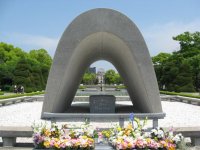
Near the center of the park is a concrete, saddle-shaped monument that covers a cenotaph holding the names of all of the people killed by the bomb. The monument is aligned to frame the Peace Flame and the A-Bomb Dome. The Memorial Cenotaph was one of the first memorial monuments built on open field on August 6, 1952. The arch shape represents a shelter for the souls of the victims.[3][13]
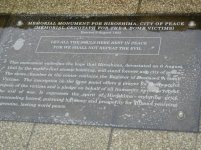
The cenotaph carries the epitaph "安らã‹ã«çœ ã£ã¦ä¸‹ã•ã„ éŽã¡ã¯ ç¹°è¿”ã—ã¾ã›ã¬ã‹ã‚‰", which means "please rest in peace, for [we/they] shall not repeat the error." In Japanese, the sentence's subject is omitted, thus it could be interpreted as either "[we] shall not repeat the error" or as "[they] shall not repeat the error". This was intended to memorialize the victims of Hiroshima without politicizing the issue, taking advantage of the fact that polite Japanese speech typically demands lexical ambiguity in the first place.[14] The epitaph was written by Tadayoshi Saika, Professor of English Literature at Hiroshima University.[15] He also provided the English translation, "Let all the souls here rest in peace for we shall not repeat the evil." On November 3, 1983, an explanation plaque in English was added in order to convey Professor Saika's intent that "we" refers to "all humanity", not specifically the Japanese or Americans, and that the "error" is the "evil of war":
The inscription on the front panel offers a prayer for the peaceful repose of the victims and a pledge on behalf of all humanity never to repeat the evil of war. It expresses the spirit of Hiroshima — enduring grief, transcending hatred, pursuing harmony and prosperity for all, and yearning for genuine, lasting world peace.
Perhaps unsurprisingly, the ambiguity of the phrase has the potential to offend; some right-wing circles in Japan have interpreted the words as an admission of guilt—implicitly reading it as "we shall not repeat the error"—and they criticize the epitaph as a self-accusation by the Japanese empire. In July 2005, the cenotaph was vandalized by a 27 year old Japanese affiliated with the Japanese right.[16]
http://en.wikipedia.org/wiki/Hiroshima_Peace_Memorial_Park#Memorial_Cenotaph