



While AMD’s next generation flagship card, the HD7970, is grabbing all the headlines with impressive performance figures – the graphics and processor company have also launched the more sanely priced HD7950.
It doesn’t match the HD7970 in terms of speed, but then again it doesn’t retail for over R6,500. Let’s see what the card is really like.
Technology overview
The HD7950 is based on AMD’s new 28nm manufacturing process, and is part of the Southern Islands series of graphics processors.
Being a HD7900 series card, the HD7950 ships with all the new technology AMD has to offer, including Eyefinity 2.0. The latest version of Eyefinity supports up to 4k displays over one output port; has intelligent bezel correction; and can split independent video and audio streams to selected monitors and more.
For a full look at Eyefinity 2.0, read the Mygaming overview.
The HD7950 also features ZeroCore technology. This is a power-saving feature that allows the card to draw less than 3w during a long idle state when the computer is on, but not powering a monitor.
Also present is intelligent power management for multi-graphics card setups. While working in a 2D environment, only the primary graphics card draws its normal amount of power, the rest are put into a long idle state.
For more on AMD ZeroCore, read the Mygaming Overview.

AMD HD7950 side
Performance
Metro 2033
Known as the new Crysis, Metro 2033 is one of the most demanding games on your hardware currently available. We played through a set level three times, and recorded the average frame rate of the level using fraps. These averages were then averaged to get the below result.
All graphics settings were maxed, while tessellation was turned off. The resolution was 1920 x 1200.
Scores:
- GTX570 – 24.5fps average
- 6950 – 25.9fps average
- 7950 – 35fps average
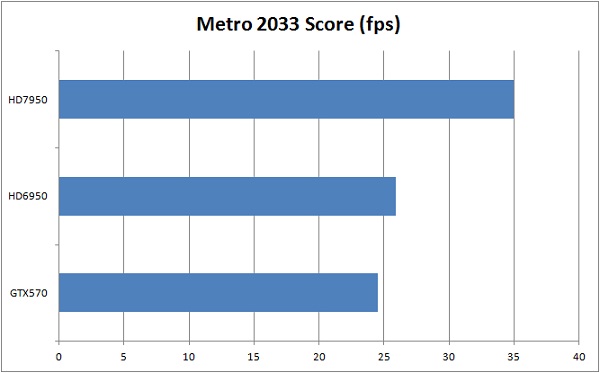
Metro 2033 scores
Unigine heaven
First up for the Synthetic benchmarks is Unigine heaven – a DirectX 11 benchmark that focuses on a variety of methods to stress modern graphics cards. We made use of the HWbot Xtreme DX11 pre-configured settings during testing, and the benchmark was run three times on each card, with the upper and lower samples disregarded.
Scores:
- GTX570 – X1257.93
- HD6950 – X885.89
- HD7950 – X1406.308
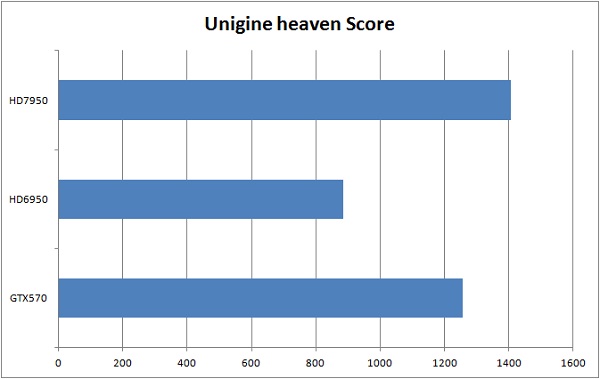
Unigine Heaven score
Trackmania
The now-outdated DirectX 9.0c standard is often ignored in modern benchmarks, and for good reason. The standard is almost completely irrelevant for modern gamers, though as a quick and easy indication of real world performance for those who (like me) still enjoy the occasional classic title – so it was added in for good measure.
Tests were run at 1920 x 1200, with all graphics settings maxed out, and AA set to 16x.
Scores:
- GTX570 – 87.3fps
- HD6950 – 65.8fps
- HD7950 – 78.2fps
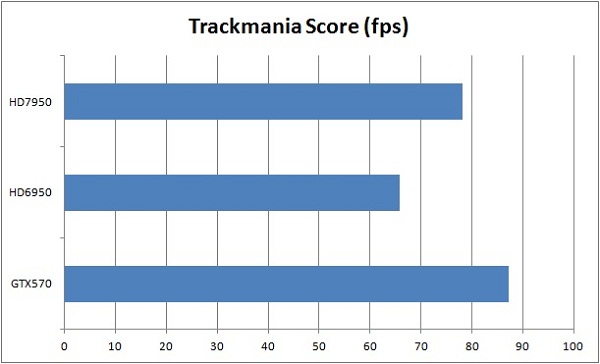
Trackmania Nations Forever scores
3D Mark Vantage
3D Mark Vantage is still one of the best synthetic benchmarks to compare current generation graphics cards. While there are still a host of DirectX 10 titles on the market, performance in this segment will remain relevant.
Scores:
- GTX570 – 25481
- GTX570 – 20719 physics off
- HD6950 – 20630
- HD7950 – 22804
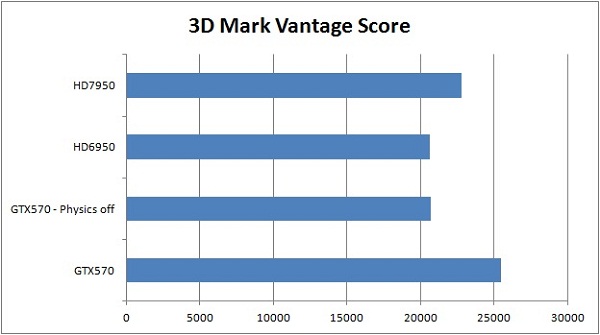
3D Mark Vantage total scores
3D Mark Vantage GPU
Scores:
- GTX570 – 21661
- GTX570 – 21657 physics off
- HD6950 – 21511
- HD7950 – 25845
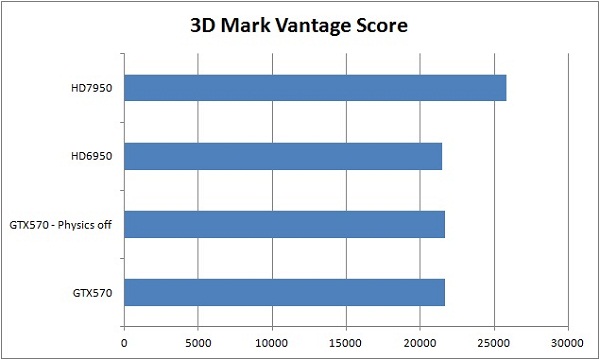
3D Mark Vantage GPU scores
Heat and noise
The 7950 runs quite cool in idle mode, hovering at between 33 and 38 degrees depending on what the rest of the system is doing. With the stock fan profile in place, the card peaked at 70c under intense load. Regular load from games kept the card hovering at 65c with the fan profile set to auto.
With the fan profile set to automatic, the card went from being barely audible at idle, to mildly noisy under max load. It was indistinguishable from a standard GTX570 in the same system under the same conditions.

AMD HD7950 ports
Conclusion
The 7950 is an impressive card to be sure – comfortably outperforming an Nvidia GTX570 and even piping the last generation flagship card (the Nvidia GTX580) in nearly all benchmarks. However this performance comes at a cost: the card will retail locally for around R5,400 – pricing it very close to the GTX580.
Still, even though it’s priced so close to its main performance competitor (for the time being), it brings the benefits of 28nm technology to the table which includes lower noise and lower operating temperatures – not to mention a lower power draw.
This along with new technologies such as AMD Eyefinity 2.0 and AMD ZeroCore makes the 7950 an attractive option for those in the market for a new graphics card.





 Loading ...

Very interesting taking a look at the benches.
I would most certainly wait for the new nVidia cards before making any decisions though.
They are quite impressive but I think nVidia may just kick a bit harder.