

AMD have unveiled their bottom of the range card aimed at lower-end gamers and HTPC users – the HD7750, based on the Graphics Core Next architecture.
Despite being full-height, the card is shorter in length than mid- or high-range cards, and takes up just a single slot thanks to its low profile cooler. Let’s see if this feature-rich card has the right mixture of gaming, temperature and noise performance to be an attractive option.
Technology overview
The HD7750 from AMD is one of the first of the Cape Verde cards aimed at the lower segment of the gaming market, as well as the HTPC market. It sports the same list of features as the higher-end HD7900 series cards, including being based on Graphics Core Next (GCN) architecture, HDMI 1.4a and DisplayPort 1.2 ports, and PCIe 3.0 interface support.
Being a HD7700-series card, the HD7750 ships with all the new technology AMD has to offer, including Eyefinity 2.0. The latest version of Eyefinity supports up to 4k displays over one output port, has intelligent bezel correction, and can split independent video and audio streams to selected monitors and more. For a full look at Eyefinity 2.0, read the Mygaming overview.
The HD7750 also features ZeroCore technology. This is a power saving feature that allows the card to draw less than 3w during a long idle state when the computer is on, but not powering a monitor. Also present is intelligent power management for multi-graphics card setups. While working in a 2D environment, only the primary graphics card draws its normal amount of power, the rest are put into a long idle state. For more on AMD ZeroCore, read the Mygaming Overview.

HD7750 Birdseye view
Performance
Metro 2033
Known as the new Crysis, Metro 2033 is one of the most demanding games on your hardware currently available. We played through a set level three times, and recorded the average frame rate of the level using fraps. These averages were then averaged to get the below result. All graphics settings were maxed, while tessellation was turned off. The resolution was 1920 x 1200.
Scores:
- GTX570 – 24.5fps average
- HD6950 – 25.9fps average
- HD7950 – 35fps average
- HD7770 – 19.7fps average
- HD7750 – 14.2fps average
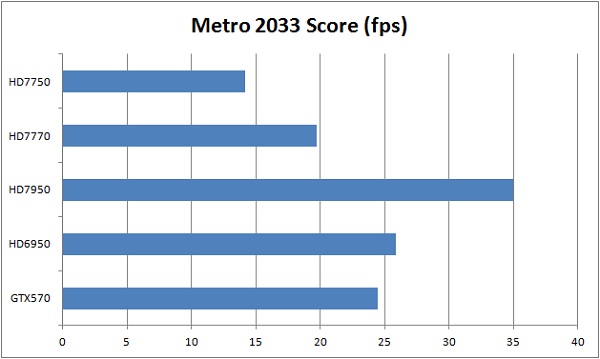
HD7750 Metro 2033 scores
Unigine heaven
First up for the Synthetic benchmarks is Unigine heaven, a DirectX 11 benchmark that focuses on a variety of methods to stress modern graphics cards. We made use of the HWbot Xtreme DX11 pre –configured settings during testing, and the benchmark was run three times on each card, with the upper and lower samples disregarded.
Scores:
- GTX570 – X1257.93
- HD6950 – X885.89
- HD7950 – X1406.308
- HD7770 – X750.41
- HD7750 – X582.45
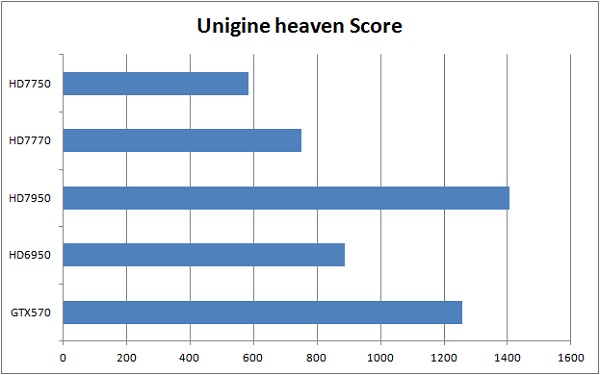
HD7750 Unigine Heaven scores
Trackmania
The now outdated DirectX 9.0c standard is often ignored in modern benchmarks, and for good reason. The standard is almost completely irrelevant for modern gamers, though as a quick and easy indication of real world performance for those who (like me) still enjoy the occasional classic title, so it was added in for good measure. Tests were run at 1920 x 1200, with all graphics settings maxed out, and AA set to 16x.
Scores:
- GTX570 – 87.3fps
- HD6950 – 65.8fps
- HD7950 – 78.2fps
- HD7770 – 50fps
- HD7750 – 45.5fps
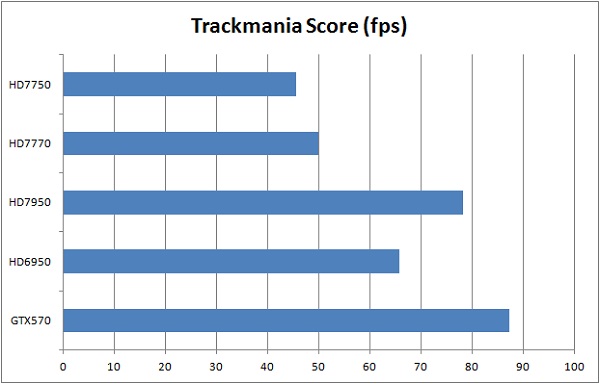
HD7750 Trackmania Nations scores
3D Mark Vantage
3D Mark Vantage is still one of the best synthetic benchmarks to compare current generation graphics cards. While there are still a host of DirectX 10 titles on the market, performance in this segment will remain relevant.
Scores:
- GTX570 – 25481
- GTX570 – 20719 physics off
- HD6950 – 20630
- HD7950 – 22804
- HD7770 – 14365
- HD7750 – 11408
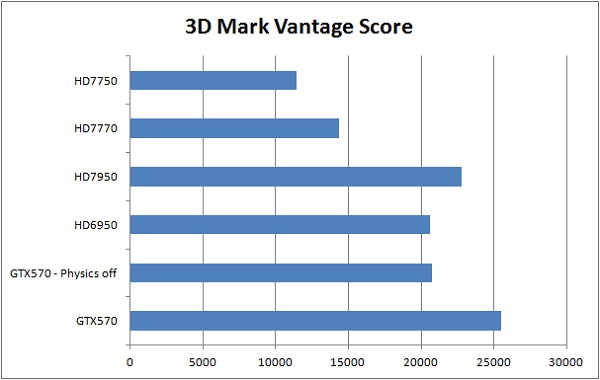
HD7750 3D Mark Vantage overall scores
3D Mark Vantage GPU
Scores:
- GTX570 – 21661
- GTX570 – 21657 physics off
- HD6950 – 21511
- HD7950 – 25845
- HD7770 – 13441
- HD7750 – 10114
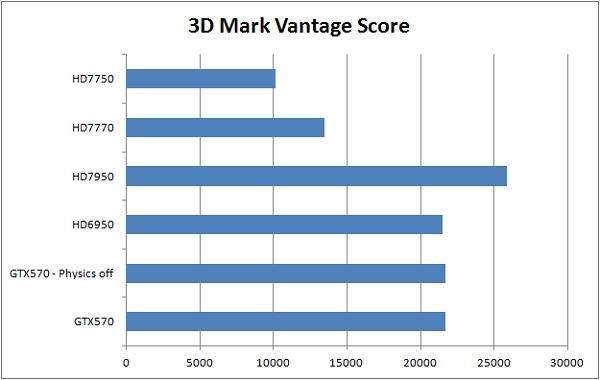
HD7750 3D Mark Vantage GPU scores
Heat and noise
Since the HD7750 is aimed at HTPC and low-end gamers, it uses a much smaller cooler than the higher-end card in the 7700 range, the HD7770. This is not a bad thing, however, as AMD has managed to keep the HD7750s TDP at around 75 watts, which means even at full load there isn’t much heat to deal with.
With this is mind, it’s interesting to note that the HD7750 performed almost exactly on par with the HD7770 in terms of temperatures.
Idle temperatures were hovering between 32 and 32 degrees in a 2D Windows environment one hour after startup, compared to 32 degrees measured on the HD7770.
Load temperatures of 61 degrees at max load with the fan profile set to automatic were also very close to the 60 degrees recorded by the HD7770.
The trade-off to these impressive temperatures despite the small cooler, however, is the HD7750 was noticeably louder than the HD7770 under load conditions. While it is not loud enough to be audible over the watercooling fans in our test bed, the HD7750 in an HTPC in a quiet environment may become noticeable to the point of irritation.
It’s worth noting that manufacturers will more than likely use their own cooling solutions, rather than the one employed by the reference designed HD7750. So expect other cards based on this GPU to be quieter.

HD7750 flat view
Conclusion
The HD7750 is an impressive option if you’re in the market for a low power card for your HTPC, or you want a dedicated gaming card on a tight budget.
The size of the card, the low 75 watt TDP and the fact that it doesn’t require an external power all count in the HD7750’s favour, along with the impressive feature list it shares with the higher end HD7900 cards.
The only issue with the card at the moment is the noise; it is noticeable enough to annoy many HTPC users. Cards from vendors such as Sapphire and XFX will probably make use of custom cooling solutions though, so those are the ones to go for over cards that use the reference cooler.
No local pricing was available at the time of publication, and the final conclusion on whether the HD7750 is a good buy or not depends on whether it is priced competitively. Once we have local pricing we will update the article accordingly.






 Loading ...