



As the AMD Radeon R300 series launch approaches, come E3’s PC press conference, we learn more and more about the upcoming cards.
There’s quite a bit to unpack, and some of the leaks aren’t 100% reliable, but it’s still exciting news for AMD fans in spite.
AMD Radeon R300 Series Roadmap
Keep in mind that this roadmap may not be official, but for now we’re going to go along with VideoCardz and assume its legitimacy.
What the roadmap demonstrates is the names of a good portion of the R300 series, which are essentially rebranded versions of the R200 series.

AMD Radeon Roadmap 2015
And for the most part, AMD has crossed out the “2” in the names of many of their cards and written in “3”, so don’t expect much more than increases in clock and memory speed, perhaps a little more VRAM.
Weirdly, AMD’s Radeon Fury cards, powered by the Fiji XT and Fiji Pro, seemed to be delayed. At least that’s what we’re assuming the slight indent to the right indicates.
It’s curious because both NVIDIA as well as AMD usually lead with their flagship cards, rather than leave them for last.
As the only new cards in the series, and the only ones to sport HBM, they’re also key to AMD’s marketing campaign as far as we’re concerned, so you’d assume AMD would opt to start off with their best foot first.
Could reports be true that NVIDIA’s GTX 980 Ti has, in fact, forced AMD to delay their Radeon Fury cards in order to tweak and improve their performance, and perhaps perfect their drivers?
| GPU | Card | 200 Series Counterpart | GCN Iteration | Mem. | GPU/Memory Frequency | Memory Bandwidth |
|---|---|---|---|---|---|---|
| FIJI XT | AMD Radeon | – | 1.2 | 4GB HBM | 1050/500Mhz | 512GB/s |
| FIJI Pro | AMD Radeon | – | 1.2 | 4GB HBM | 1000/500Mhz | 512GB/s |
| Grenada XT | AMD Radeon R9 390X |
Radeon R9 290X | 1.1 | 8GB | 1050/1500 MHz? | 384 GB/s |
| Grenada Pro | AMD Radeon R9 390 |
Radeon R9 290 | 1.1 | 8GB | 1010/1500 MHz? | 384 GB/s |
| Antigua XT | AMD Radeon R9 380X | Radeon R9 M295X | 1.2 | 6GB/4GB | TBD | TBD |
| Antigua Pro | AMD Radeon R9 380 | Radeon R9 285 | 1.2 | 4GB/2GB | 970/1425 MHz | 182 GB/s |
| Trinidad XT | AMD Radeon R7 370 | Radeon R9 265 | 1.0 | 4GB/2GB | 975/1400 MHz | 179 GB/s |
| Tobago XT | AMD Radeon R7 360X | AMD Radeon R7 260X | 1.1 | 4GB/2GB | 1050/1750 MHz | 112 GB/s |
| Tobago Pro | AMD Radeon R7 360 | AMD Radeon R7 260 | 1.1 | 2 GB | 1000/1750 MHz | 112 GB/s |
*Table courtesy of WCCF Tech. Prices have been removed and detailed below.
At the very least, we have more details regarding the Radeon Fury X and Fury’s specs. Sadly, no prices have been included.
We’re going to assume that the water cooled Fury X is the Fury Nano we’ve heard rumours about.
| Fury X (Water Cooled) | Fury X (Air Cooled) | Fury (Air Cooled) | R9 290X | |
|---|---|---|---|---|
| GPU | Fiji XT | Fiji XT | Fiji Pro | Hawaii XT |
| Stream Processors | 4096 | 4096 | 3584 | 2816 |
| GCN Compute Units | 64 | 64 | 56 | 44 |
| Render Output Units | 128 | 128 | 128 | 64 |
| Texture Mapping Units | 256 | 256 | 224 | 176 |
| GPU Frequency | ≥ 1050Mhz | 1050Mhz | 1000Mhz | 1000Mhz |
| Memory | 4GB HBM | 4GB HBM | 4GB HBM | 4GB GDDR5 |
| Memory Interface | 4096bit | 4096bit | 4096bit | 512bit |
| Memory Frequency | 500Mhz | 500Mhz | 500Mhz | 1250Mhz |
| Effective Memory Speed | 1Gbps | 1Gbps | 1Gbps | 5Gbps |
| Memory Bandwidth | 512GB/s | 512GB/s | 512GB/s | 320GB/s |
| Cooling | Liquid, 120mm Radiator | Air, 3 Axial Fans | Air, 3 Axial Fans | Air, Single Blower Fan |
| Performance (SPFP) | ≥ 8.6 TFLOPS | 8.6 TFLOPS | 7.2 TFLOPS | 5.6 TFLOPS |
| TDP | 300W | 300W | 275W | 290W |
| GFLOPS/Watt | ≥ 28.7 | 28.7 | 26.2 | 19.4 |
| Launch Price | TBA | TBA | TBA | $549 |
*Table courtesy of WCCF Tech.
And just by the way, according to one of WCCF Tech’s sources, Star Wars: Battlefront will be packed in with some of the Radeon cards.
If true, that’s $60 (or around R700) extra thrown in for free.
Benchmarks
Now for the truly juicy details.
Thanks to some super spy work by VideoCardz, we have 3DMark FireStrike benchmarks for the Radeon Fury X.
Granted, 3DMark’s FireStrike benchmark is a synthetic test and not directly proportional to real world results, but it’s nevertheless a good indicator of expected performance.
And would you look at that, at 4K resolution (FireStrike Ultra), the Fury X edges ahead of the GTX Titan X, although only marginally.
It’s undoubtedly as a result of Fiji’s use of high bandwidth memory and its absurd bandwidth as a result.
Once we drop below 4K resolution (FireStrike Extreme), the GTX Titan X takes the lead once more, but it’s worth mentioning that the Fury X does beat out the GTX 980 Ti.

AMD Radeon Fury X – 3DMark FireStrike Scores. Image courtesy of VideoCardz.
We expect the Radeon Fury X, especially locally, to cost quite a bit more than the GTX 980 Ti, so NVIDIA’s latest card will likely be the best option for high-end performance relative to cost.
It’s also interesting to note that the Hawaii Pro (R9 390) and Hawaii XT (R9 390X) cards comfortably beat out the GTX 970. At $329 and $389 respectively, they may well beat out the GTX 970 (also around $329) for the best performance/price value crown.
Should you need a little more in terms of benchmarking, CompuBench OpenCL benchmarks of the Fiji GPUs demonstrate a pretty serious advantage for AMD.
-
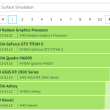
- AMD Fiji GPU Benchmarks – OpenCL CompuBench
-
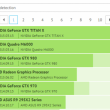
- AMD Fiji GPU Benchmarks – OpenCL CompuBench
-
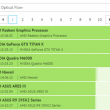
- AMD Fiji GPU Benchmarks – OpenCL CompuBench
-
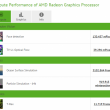
- AMD Fiji GPU Benchmarks – OpenCL CompuBench
That said, further 3D graphics performance tests, via the GFXBench OpenGL, demonstrate the GTX Titan X in the lead once more.
It’s not the most accurate test, but we’re becoming pretty certain that the Radeon Fury X and GTX Titan X are going to be fairly close competitors.

AMD Fiji-Fury X vs GTX TITAN X – GFXBench OpenGL Benchmark. Image courtesy of WCCF Tech.
For those AMD fans, it’s probably a little anti-climactic to close with an NVIDIA win, so how about we change that.
Fast as the GTX Titan X may be, we’ve got some images of the Radeon Fury X card and a glowing Radeon logo while the card is powered. Thanks WCCF Tech!

AMD Radeon Fury X – Glowing Radeon Logo – Lit Case

AMD Radeon Fury X – Glowing Radeon Logo – Unlit Case
Source: VideoCardz & WCCF Tech
More AMD news
AMD’s Radeon Fury GPU reported to arrive in 3 flavours
AMD demonstrates its Fiji GPU, but not Radeon Fury X: NVIDIA must’ve scared them
AMD’s new flagship Radeon Fiji XT looks to burn the competition






 Loading ...

Take these benches with a pinch of salt, they reek of fabrication. I will wait patiently for official reviews after E3.