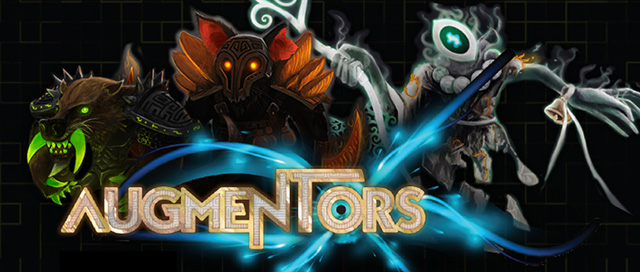


Augmentors, a blockchain-based augmented reality game for Android and iOS, has soft-launched in South Africa.
Developed in South Africa, two of the game’s co-founders appeared on Shark Tank South Africa in 2016 where they secured an investment in Bitcoin from Vinny Lingham.
Kyle Haffenden and Michael Deon initially pitched the idea of selling packs of cards with images printed on them that act as triggers for the game’s augmented reality engine.
These images would correspond to different creatures (Augmentors) in the game, which players could summon for battle by pointing their smartphone’s camera at the card.
While the game would be a free download from Google Play and the App Store, the plan was to make money from selling card packs.
However, Lingham’s proposal to Haffenden and Deon was to use blockchain technology to create the various levels of rarity for creatures, rather than printed trigger cards.
Lingham went on to offer an investment of R500,000 — “around 59 Bitcoin” — for 20% equity in Augmentors. He opened the offer to Gil Oved, co-founder of The Creative Counsel advertising agency, who agreed to invest as well.
Augmentors: The Game
Augmentors is a multiplayer creature combat game with some collectible card game and deck-building mechanics.
Much like other digital collectible card games, such as Hearthstone, Augmentors uses a freemium model.
The game is free to play, and as you battle other players you earn rewards and in-game currency which may be spent on upgrades.
Rewards are granted in packs called portals that require time to unlock. Portals contain ability cards, and may also contain single-use items called relics.
Each Augmentor has two unique abilities – one attack and one defence. You must then select another nine abilities to build a “deck”. Your hand consists of four abilities, randomly drawn from your deck.
If you gain abilities from a portal that you already have, these duplicates may be put towards upgrading your abilities.
It is also possible to buy premium treasure portals with real-world money, ranging from R14.99 to R1,499.99.
Emeralds
Augmentors also uses an in-game currency called Emeralds, which is linked to a cryptocurrency called Databits (DTB) – which runs on the Bitcoin blockchain.
Following the investment from Lingham, the company went on to raise additional funding through an initial coin offering which ran for 30 days from 30 January 2017.
It issued just under 23 million Databits and raised 895 bitcoin (around $1 million at the time).
When the game officially launches, the developers say it will be possible to exchange DTB for Emeralds, and back.
“Augmentors will keep DTB in a reserve to maintain a fixed ratio of 1 DTB to 1,000 Emeralds. So, as the game gains popularity, the amount of DTB stored in the reserve will continue to grow due to increased number of Emeralds in circulation,” the company said.
“This was done because using DTB directly in the game introduced technical, user interface, and regulatory issues.”
Currently, Emeralds may only be used to buy gold or immediately open portals, which usually take 3.5 hours to unlock.
However, in future, Emeralds will be the currency used in the auction house and the in-game marketplace where creatures, relics, and skins may be purchased.
Rarity and trading
When Haffenden and Deon first pitched Augmentors to Shark Tank, one of the key features they wanted to drive was the social aspect of the game. They wanted to create a multiplayer video game that got players together in the real world.
Blockchain technology could not facilitate this part of their dream, but it is helping to release another aspect of it – a system of real-world rarity and value for digital assets.
While some games do have mechanisms for trading in-game currency or value for real-world value, systems that allow a direct exchange of game items or in-game currency for cash is rare.
Games like Eve Online and World of Warcraft link their in-game currency to the price of a monthly subscription, giving it real-world value. Many other games let you buy a premium currency with real money, which may then be exchanged for assets in the game.
These fiat currency to in-game value exchanges are typically one-way, though. There is usually no way to cash out unless you use a black market. Notable exceptions include Second Life.
Diablo 3 also featured a real money auction house from June 2012 until March 2014. Blizzard shut down the auction house, however, because it undermined Diablo’s core gameplay.
“The creatures are non-fungible tokens, which means that each individual creature is unique. This differs from fungible tokens, such as Bitcoin, where each token is identical,” Augmentors said.
The company said it will use the ERC-721 standard for its non-fungible creature tokens.
Among the benefits of using ERC-721 is true ownership, provable scarcity, and inter-game operability.
An alpha version of Augmentors is available for download in South Africa. Currently, the auction house and other trading features are not available.






 Loading ...