Is there anything really wrong with using a tv as a monitor?

I find it very hard to focus on the screen and after a few minutes my eyes become very sore...

I would not recommend it, maybe if you were some gunnar...

Larger screens have more pixel spacing (larger pixels),if you are sitting close to the screen then you need to get a higher resolution one.

I have a 1920x1080 monitor and TV both hooked up to my PC(TV is about 20-30% bigger then the monitor) and the difference is quite noticeable.
 
Larger screens have more pixel spacing (larger pixels),if you are sitting close to the screen then you need to get a higher resolution one.

I have a 1920x1080 monitor and TV both hooked up to my PC(TV is about 20-30% bigger then the monitor) and the difference is quite noticeable.

Its a 40" hd samsung and i was sitting about 3 metres away...

As said earlier it may be the ghosting...
 
Use whatever makes you comfortable,I'm planning on using a TV as a monitor cause......why not.
It's bigger,better value for money and you can game better on it and watch your series/movies/anime on it.
 
Use whatever makes you comfortable,I'm planning on using a TV as a monitor cause......why not.
It's bigger,better value for money and you can game better on it and watch your series/movies/anime on it.

Some people say smaller screens are better for FPS games, but I agree that for some games it is better :D
 
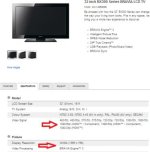
I use a 32" Sony Bravia for all my gaming and PC usage. It is a Full HD panel .... bUt.... Something to watch out for is the native resolution of the tv. Even if it says full HD (1080p) its native resolution is my case is 1360x768. So I have to use that as my desktop resolution to have crisp and clear text but all my games run in Full HD with no ill effects or blurriness... BF4 is luverley....
 
I use a 32" Sony Bravia for all my gaming and PC usage. It is a Full HD panel .... bUt.... Something to watch out for is the native resolution of the tv. Even if it says full HD (1080p) its native resolution is my case is 1360x768. So I have to use that as my desktop resolution to have crisp and clear text but all my games run in Full HD with no ill effects or blurriness... BF4 is luverley....

Say... what?

I've never heard of that before. The native resolution of an HD TV is supposed to be 1920x1080 (hence the 1080p bit).

Someone will have to explain to me how a TV can have a lower native resolution than 1080p but call itself a "full HD 1080p" display.

Didn't know that was "allowed."
 
Say... what?

I've never heard of that before. The native resolution of an HD TV is supposed to be 1920x1080 (hence the 1080p bit).

Someone will have to explain to me how a TV can have a lower native resolution than 1080p but call itself a "full HD 1080p" display.

Didn't know that was "allowed."

On my Samsung 32" that I am using at the moment it has the same thing. If I go to the resolution properties the Native one is 1280x720. If you go above it its refresh rate drops to 30Hz, until you reach 1080p where it is 59Hz (Apparently).
 
Say... what?

I've never heard of that before. The native resolution of an HD TV is supposed to be 1920x1080 (hence the 1080p bit).

Someone will have to explain to me how a TV can have a lower native resolution than 1080p but call itself a "full HD 1080p" display.

Didn't know that was "allowed."

Here is a picture with the specs that I took off Sony's website to show.

tv.jpg
 
Weird. I guess they get away with calling it an HD TV because its native resolution is higher than 1280x720.

Learn something new every day.

How does it look when it shows 1080p? As in, what would the obvious differences be between native and non-native?

I'd imagine a degree of image degradation? :confused:
 
When buying a TV you must also look if it says HD Ready or Full HD. HD Ready TVs are usually 720p whereas a Full HD TV will provide a 1080p picture through and through.
 
Where does it say Full HD? Looks like you may be confusing supported input resolutions with output resolution. It could support a 4K input signal and still output 720p.

When buying a TV you must also look if it says HD Ready or Full HD. HD Ready TVs are usually 720p whereas a Full HD TV will provide a 1080p picture through and through.

This is the answer :)

My opinion on InSanity's TV conundrum:

As some have mentioned, refresh rate, response time, and pixel density are all important considerations.

I reckon 32-inch is a good size for using a TV as a monitor, in terms of pixel density. Larger panels mean you need to sit further away. It kind of negates any benefit of having larger real-estate in desktop usage scenarios. I know this from experience - hooked up my 46-inch for a while and while it looked great, I had to sit on the other side of the living room and after a while my eyes were bleeding. It also became difficult to do regular desktop stuff; browsing, writing, etc.

You'll really want to make sure you have as low a response time as possible, and at least a 60Hz refresh rate. Backlighting type will also be important, as well as contrast ratio.

A few things I haven't seen mentioned: image processing and possible sound output lag.

Firstly, note that most TVs come with some sort of image processor built-in. You must try choose a TV with advanced software UI that enables to disable (or mostly disable) the TVs image processing. Your GPU will be doing this work and having your TV as an extra layer of image processing will result in a sluggish input lag feeling.

Secondly, due to image processing lag, the picture on screen might be behind your sound output. This happens if you use the HDMI output on your GPU to the TV, but use a different sound source, such as a discrete sound card, or the analog sound outputs on your motherboard. Modern GPUs pass-through the audio signal along with the video signal, so if you run your audio over the HDMI as well, you won't have this lag. This is also from experience. The sound lag isn't too noticeable in games (depending on what you are playing), but it becomes immensely irritating when watching TV shows and movies when the lip don't sync to the audio.

Gotta dash, hope this helps!
 
Where does it say Full HD? Looks like you may be confusing supported input resolutions with output resolution. It could support a 4K input signal and still output 720p.

True, true, eish but salesman can lie thru their teeth... but even then I still would use this TV anyday as my monitor. I like it and I have no problems with input lag or fuzziness (if I run it at 1360x768).

Quick question - if 720p is equal to 1280x720, so basically do I have slightly-better-than-HDReady-but-still-need-bit-to-go-to-FullHD with my native resolution set at 1360x768?
 
I use a 32" Sony Bravia for all my gaming and PC usage. It is a Full HD panel .... bUt.... Something to watch out for is the native resolution of the tv. Even if it says full HD (1080p) its native resolution is my case is 1360x768. So I have to use that as my desktop resolution to have crisp and clear text but all my games run in Full HD with no ill effects or blurriness... BF4 is luverley....

Can't you dual screen and let the GPU auto set the TV's resolution? I can do that with my old 5 series Samsung. PC at 1600x900 and TV at 720p with no loss in quality.

Say... what?

I've never heard of that before. The native resolution of an HD TV is supposed to be 1920x1080 (hence the 1080p bit).

Someone will have to explain to me how a TV can have a lower native resolution than 1080p but call itself a "full HD 1080p" display.

Didn't know that was "allowed."

Could be a HD Ready TV, they only go up to 720p. Also you can push 3000 x 4000 to the TV but it will downscale to 720p anyway.
 
True, true, eish but salesman can lie thru their teeth... but even then I still would use this TV anyday as my monitor. I like it and I have no problems with input lag or fuzziness (if I run it at 1360x768).

Quick question - if 720p is equal to 1280x720, so basically do I have slightly-better-than-HDReady-but-still-need-bit-to-go-to-FullHD with my native resolution set at 1360x768?

Do you mean 1366x768? They are very similar except the 1366x768 display is going to be able to display sources at 1024x768 without any loss in vertical resolution
 
Back
Top