

Arcade gaming has been a staple of entertainment in South Africa; however, the advancement of the gaming industry has seen a decline in the popularity of these once frequently visited establishments.
Currently, you can still find arcade-style stores in shopping centres, usually filled with young children and their parents enjoying the games on offer.
However, although there is still a demand for physical gaming entertainment, the growing prevalence of Virtual Reality (VR) gaming could present a threat.
Virtual Reality allows one to experience games and activities almost the same as physically taking part.

VR Headsets allow for a unique gaming experience.
Whatever you can imagine, bowling, climbing, or fighting can potentially become a VR game available on sites such as Steam.
However, the one challenge of VR is the associated price tag of purchasing not just the VR equipment but also the games and the PC or Console required to run the gear and play.
The overall price of VR tech, in particular, is likely to decline as it becomes more popular, but currently, it’s still costly.
That then presents the issue for arcades; currently, the high price of VR ensures that many will still frequent them for entertainment, but eventually, when the cost of Virtual Reality has dropped, their appeal may decline.
Simply buying your child a game on Steam or from an online store and letting them play it at home is far more convenient than driving out to an arcade and paying for the time needed to play.
The question then is what arcades can do to ensure they will not disappear entirely in the future.
One solution is for arcades to incorporate VR into their available features, offering a far more economical option for the experience than purchasing the equipment and games yourself.
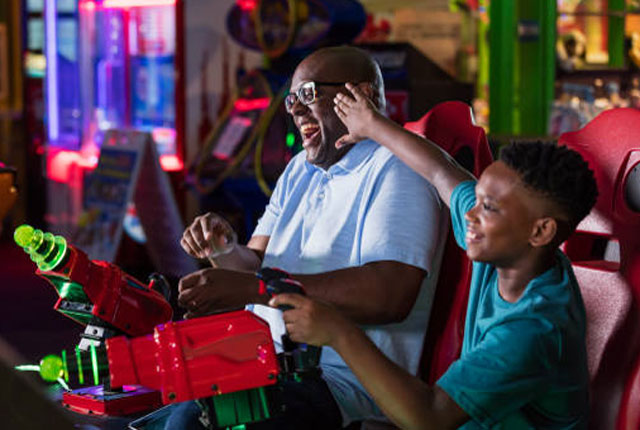
A father and son enjoy their time at an Arcade.
As it happens, this approach has already been tried, as in 2019, an arcade called Virtual Realms opened in Cape Town fully dedicated to offering its customers the VR experience.
You can read here if you’d like to know more about the arcade.
However, as of writing, Virtual Realms has closed, having only been open for a few years.
It is more than likely that the rise of Covid-19 and the health concerns and restrictions it brought may have played a part in the closure.
However, it’s also possible the current cost of maintaining and even paying to use VR is too high for a sustainable business.
As a result, arcades in South Africa occupy an uncertain position in the market.
They are still used but are no longer as prevalent as they once were; whether this will continue remains to be seen.
For now, arcades are still around, and it’ll likely stay that way for some time.
Read: Microsoft confirms Call of Duty franchise won’t become exclusive





 Loading ...