



Upgrading your PC has to happen eventually – if you keep waiting for “the next big thing that’s just around the corner” in the tech industry you’d never get around to actually buying parts. That said, now might not be the best time to upgrade your CPU and motherboard.
Telling you to hold off on upgrading your CPU and motherboard shortly after the release of the impressive Intel Ivy Bridge platform, or the now-established AMD Bulldozer platform may seem strange; however looking forward at each company’s plans may make you reconsider your next upgrade.
What’s currently available?
Intel
In the Intel corner we have the recently released Ivy Bridge platform.
Ivy Bridge launched in April 2012, and made use of a new 22nm manufacturing process (compared to 32nm used by Sandy Bridge). The chips are backwards compatible with Sandy Bridge motherboards since they make use of the same LGA1155 socket, and offer many of the same features as Sandy Bridge such as PCI Express 3.0 support and tri-gate transistor technology.
Ivy Bridge offers performance increases over the older Sandy Bridge processors, though there have been reports that the chips run hotter than Sandy Bridge when they are overclocked.
Intel also offers the Sandy Bridge-e range of processors on the X79 platform for performance enthusiasts.
X79 makes use of the LGA2011 socket, and is meant to replace the X58 platform as Intel’s top end consumer offering. The accompanying Sandy Bridge-E processors are based on the 32nm Sandy Bridge micro architecture, and sport the same feature list as the more mainstream Sandy Bridge offerings. They do however have 4 to 8 cores, higher than the 4 core maximum of Sandy Bridge and Ivy Bridge processors.

Intel Ivy Bridge CPU
AMD
AMD meanwhile have their latest platform, Bulldozer, currently available to gamers.
Bulldozer was an entirely new architecture for AMD, and was the company’s first consumer focussed 8 core processor. It launched to mixed reviews, along with the socket AM3+ platform.
The AM3+ socket will be used for future AMD processors, meaning upgrading can be as simple as buying a new AMD processor and updating your motherboards BIOS.
Read the Mygaming overview of Bulldozer for a full list of features and performance.

Not an AMD Bulldozer
What’s coming in the next few months?
Intel
Intel’s Ivy Bridge replacement will be Haswell, with rumours pointing to a release sometime between March and May 2013.
Haswell is Intel’s “tock”, a completely new architecture based on the same 22nm manufacturing process Ivy Bridge chips are built on.
A new socket will accompany Haswell on release, LGA 1150. This won’t be compatible with the current socket LGA 1155 used by Sandy Bridge and Ivy Bridge, which means in less than a year you won’t be able to upgrade your motherboard and keep your current CPU, and vice versa.
If previous generation Intel releases serve as an indication of performance increases from one architecture to another, Haswell will be worth the wait if your current gaming machine will have enough grunt until then.
The other Intel offering on its way is Ivy Bridge-E, enthusiast cores for the X79 chipset based on the Ivy Bridge architecture.
Ivy Bridge-E CPUs will feature 6 and 8 core processors based on the 22nm manufacturing process. They are expected to enjoy similar gains over Sandy Bridge-E as the mainstream Ivy Bridge chips enjoyed over mainstream Sandy Bridge chips.
These chips have reportedly been delayed until the second half of 2013.
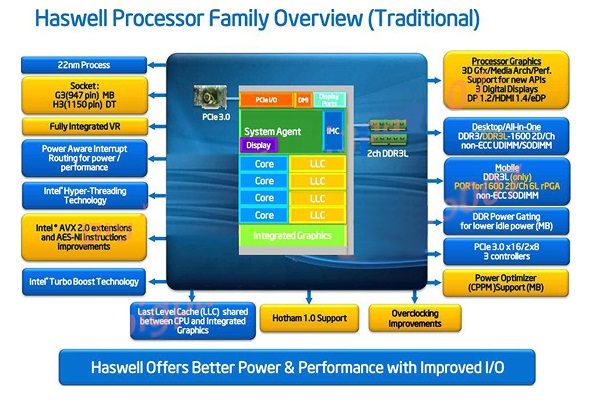
Intel Haswell feature diagram
AMD
AMD have a few unreleased products coming in the next year, the first of which is their range of Trinity APU desktop parts.
The company has already released the Trinity APUs, which integrate a CPU and GPU onto one die, for notebooks and ultra-portables, and expect to release the desktop parts in June this year.
Trinity APUs offer improved performance over AMDs previous generation APU range, Llano, and bring a host of features to the table.
The chips will feature Eyefinity support, dual graphics support (allowing the APUs GPU to crossfire with a discrete graphics card) and AMD Media Accelerator. The APUs also makes use of the accelerated app ecosystem, which means certain apps such as VLC media player and Adobe Photoshop CS6 are optimised for AMD APUs. For the full Trinity feature list, read the Mygaming overview.
For performance enthusiasts, AMD also have the second generation of FX-series Bulldozer processors coming out, codenamed Vishera.
Vishera replaces the first generation Zambezi FX processors, and is rumoured to launch in September 2012.
The new processors will be compatible with existing socket AM3+ motherboards, and AMD claims they will offer a 20 to 30 percent performance increase during media workloads over first generation CPUs.
The CPUs are also expected to be more power efficient and produce less heat than previous generation parts.

AMD FX logo CPU
So should you wait?
The answer, as always, depends on your current situation.
If your current CPU and motherboard will last until the next platform releases, it’s worth the wait.
Those considering buying an Ivy Bridge CPU and motherboard now should be aware that Haswell will feature a new motherboard socket, which means in less than a year your CPU will be replaced with a newer version that isn’t compatible with your motherboard.
If you’re considering buying an X79 motherboard with a Sandy Bridge-E processor, this isn’t such a bad move. The replacement Ivy Bridge-E processors will be out sometime next year, and will make use of the same LGA2011 pin socket found on current motherboards, making upgrading the CPU easy.
Likewise if you’re interested in buying an AMD socket AM3+ motherboard, future generation AMD processors will fit into the same socket. However do note that in less than 5 months the current generation Zambezi Bulldozer processors will be replaced with more powerful Vishera. At the very least this should cause first generation processors to drop in price, so it’s worth the wait even if you aren’t planning on upgrading to the latest technology.
Finally if you’re holding out for AMD Trinity APU desktop parts, bear in mind that the FM2 socket used by Trinity APUs is not compatible with the FM1 socket used by the previous generation Llano parts.
Related Articles
4 examples of shameless game branding
SA hard disk drive cost per GB value comparison
South African SSD prices compared






 Loading ...

Exactly, I have skipped the 1366 and (so far) the 1155 and 1156 platform and a new 1150 is already on its way?
Just the 4GB DDR2 RAM limit on my 775 mobo that might prompt me to upgrade.
in the meantime, SSD, better kb+mouse, headphones, bigger monitor 🙂