


With fibre on the horizon, we wanted to know how far we could push our old ADSL lines.
Knowing that the bill consumers pay for 10 Mbps each month is sometimes only a fraction of what the line can actually handle, we set out to determine whether it is worth it upgrading to a new data package.
The first stop is checking out Telkom’s coverage map.
By putting in your home phone number you can discover not only what deals you qualify for, but the top line speed being offered by Telkom in the area.
Obviously if you are already paying for the top package shown, you may be waiting a while longer for further improvements to come to the area.
There are a number of other factors to consider that may prevent you from achieving the top line speed possible.
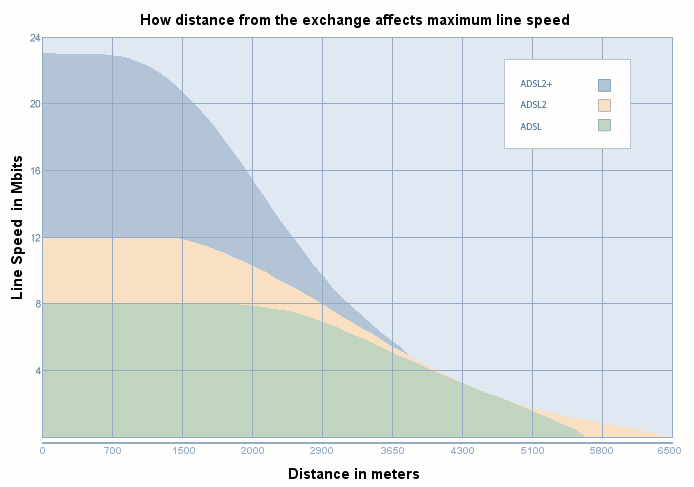
Chief among these is how far away from the exchange you are, as the coverage map won’t be as accurate in more remote locations.
This distance is represented by a number known as your “Line Attenuation” and can be found by logging directly into your router and searching your ADSL line statistics.
- 20dB and below is outstanding
- 20dB-30dB is excellent
- 30dB-40dB is very good
- 40dB-50dB is good
- 50dB-60dB is poor and may experience connectivity issues
- 60dB or above is bad and will experience connectivity issues
In your router settings you should also find the amount of “noise” on your line.
“You will be familiar with this noise when you hear crackling and noises on the line when making phone calls.”
“Even with noise on the line that causes you to miss some of the words you can still understand the conversation. Unfortunately, digital communication does not tolerate missing data and any missing information has to be re-sent and these delays reduce your download speed.”
Check out this guide for more on what is considered acceptable Line Attenuation and Noise ratio.
More gaming news
One team dominates South African eSports – is that a good thing?
The one bad thing every reviewer is saying about the PS4 Slim






 Loading ...

Many gaps:
1. How to measure the actual performance, not the potential performance you maybe might get. Is there a freely-available app to measure this?
2. The distance / attenuation plot assumes copper all the way from the exchange to the subscriber. in the real world, Telkom uses a mixture of fibre and copper for the connection, so the “distance” is really only how far from the fibre – copper changeover – at a district or street-level connection box. (Telkom assumes that fibre cables are less stealable than pure copper.)